
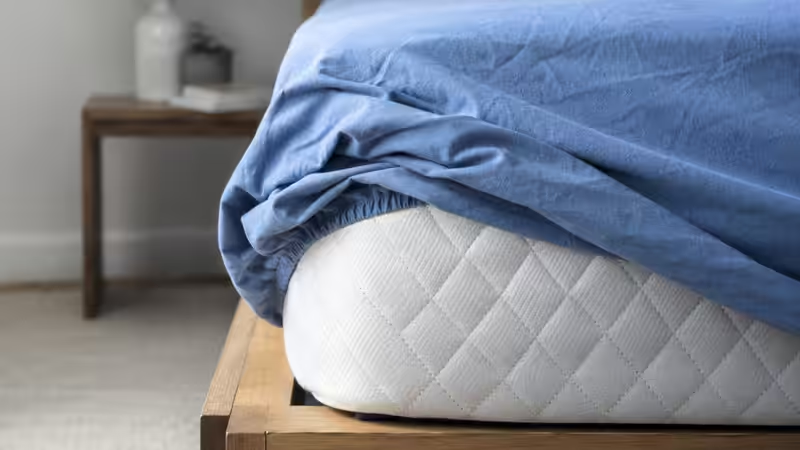
If fitted sheets keep coming off after delivery, the problem is not always the end customer.
In bulk bedding orders, fit issues often start before production: the pocket is too shallow, the fabric shrinks, the elastic loses recovery, or the sewing detail is not controlled.
We reviewed 412 fitted sheet pop-off complaints from our own orders over a three-year period. That review changed how we check fitted sheet specs before cutting.
In this guide, I’ll walk through what we found, how elastic choices affect fit, and what buyers should confirm before a fitted sheet bulk order starts.
Let’s start with the detail that caused the most trouble.
What 412 Fitted Sheet Pop-Off Complaints Taught Us
When a fitted sheet keeps slipping off the mattress, it is easy to blame the consumer.
Maybe the sheet was not pulled down far enough. Maybe the mattress was thicker than expected. Maybe the package size was misunderstood.
Those things happen.
But in bulk fitted sheet programs, the main issue often sits further upstream.
For this review, we assigned each complaint to the main cause we found during checking.
Pocket Depth Came Up First
About 66% of the complaints were linked to pocket depth.
In some cases, the pocket was too shallow from the start. In others, the fabric shrank after washing, and the usable pocket depth no longer matched the actual mattress height.
Around 19% of the complaints came from elastic that lost recovery after repeated use or laundering.
About 10% came from fabric shrinkage that changed the overall fit of the sheet.
The remaining 5% came from stitching or labeling issues.
So when a fitted sheet keeps coming off, I do not check the package size first.
I check the finished pocket depth after washing.
That is usually where the answer starts.
A Case That Made the Problem Clear
One retail order made this lesson clear.
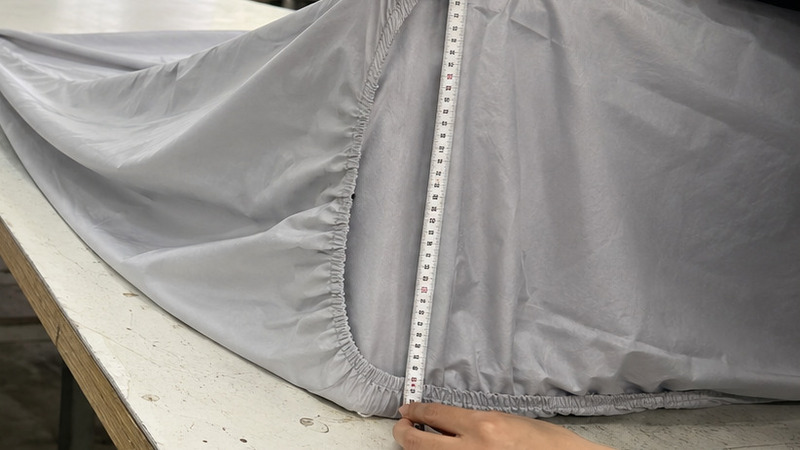
It was a 5,000-piece order of 60s cotton fitted sheets. The sheets were labeled for mattresses 10–12 inches deep, or about 25–30cm.
On paper, the spec looked workable.
About three weeks after delivery, complaints started coming in. Consumers said the corners would not stay tucked. Some said the fitted sheet pulled loose during the night.
When we checked the order again, the problem was simple.
The mattresses in that market were closer to 12.5–13 inches deep, or about 32–33cm.
The finished pocket depth in that batch was about 11 inches, or 28cm.
The fabric had not been pre-shrunk.
After the first wash, the fabric shrank by about 3.5%. That brought the usable pocket depth down to around 10.5 inches, or 27cm.
A 10.5-inch pocket will not hold well on a 12.5-inch mattress.
It is going to pull off.
What We Changed After That Order
We fixed the order first.
We stopped the remaining shipment and remade 4,500 pieces with a deeper pocket and pre-shrunk fabric.
Then we changed how we confirm fitted sheet specs.
Before production, we now ask buyers to confirm the actual mattress height, not just the size name or a general depth range.
We also check whether the mattress will be used with a mattress pad, protector, or topper.
Those extra layers matter.
Before this case, we used mattress height plus about 1.5 inches as the basic margin.
That looked fine on a spec sheet, but it was not enough in real retail use.
Now we usually start with mattress height plus about 3 inches. Then we adjust for shrinkage, elastic type, and market use.
After we made this change, depth-related complaints dropped by roughly 80%.
That is why I tell buyers to check pocket depth before looking for other ways to keep fitted sheets on the bed.
Once the pocket depth is right, I look at the elastic.
All-Around Elastic vs. Corner Elastic
Most fitted sheets use either all-around elastic or corner elastic.
Both can work. They are just built for different types of orders.
Where All-Around Elastic Helps
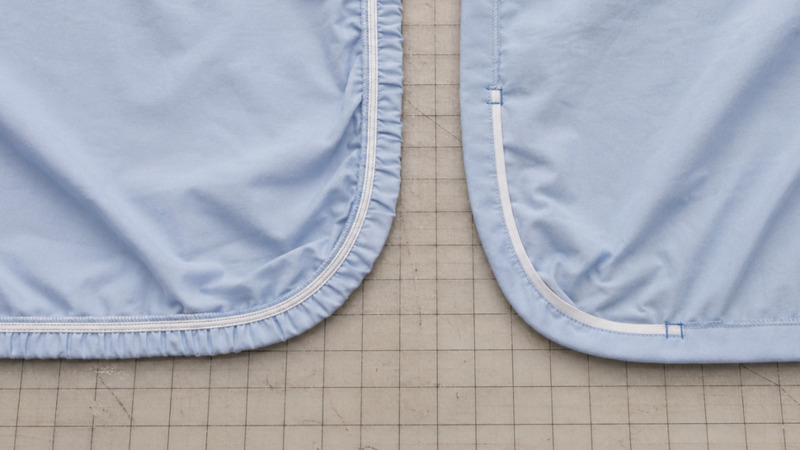
All-around elastic runs around the full perimeter of the fitted sheet.
It spreads tension more evenly around the mattress, so the sheet has a better chance of staying in place after use and washing.
This matters in the U.S. market, where many mattresses are thicker or used with mattress pads, protectors, or toppers.
For mainstream retail, online bedding, rental, and private label fitted sheet programs, all-around elastic is usually the safer choice.
It costs more than corner elastic, but it can help reduce fit complaints and returns.
Where Corner Elastic Still Makes Sense
Corner elastic is sewn only into the four corners.
It uses less elastic and less sewing time, so the unit cost is lower.
That is why it is common in entry-level fitted sheets, promotional bedding, and price-sensitive retail programs.
Corner elastic can work well on standard-height mattresses.
But it leaves less room for error.
Pocket depth, fabric shrinkage, and elastic recovery all need to be controlled more carefully.
If the mattress is thicker or used with a topper, a corner-elastic fitted sheet may pass a quick fitting check and still pull loose after regular use.
The Simple Rule I Use
Use corner elastic when the mattress spec is clear, the price point is tight, and the order is for basic retail.
Use all-around elastic when the sheet needs to handle thicker mattresses, frequent washing, or a lower tolerance for fit complaints.
Elastic construction helps, but it cannot fix the wrong pocket depth.
If the pocket is too shallow, even good elastic will struggle.
Elastic Material and Sewing Still Matter
Once the construction is set, I check the elastic itself.
A fitted sheet can have the right pocket depth and the right elastic layout. But if the elastic does not recover well after washing, the sheet will still start to slip.
What We Saw in Wash Testing
In 2023, we tested three elastic options on the same 40s cotton fitted sheet construction.
The fabric, sewing method, and wash conditions stayed the same.
Only the elastic changed.
We used AATCC 135-based home laundering conditions, with 60°C washing and tumble drying. Then we checked elastic recovery after washing.
Standard rubber elastic looked fine early on.
But recovery dropped to about 72% after 20 washes and roughly 52% after 50 washes.
At that point, the sheet no longer held the mattress well.
Imported latex elastic held up better.
It kept about 85% recovery after 50 washes.
That is why I usually prefer it for retail, online bedding, and private label fitted sheet programs.
It costs more, but it gives a better balance of cost and durability.
How I Use Silicone Grip Points
Silicone grip dots helped at first, but they were not a full answer.
After about 30 washes, the silicone started to flake.
Customers may see that as a defect.
For deep pocket fitted sheets or thicker mattresses, silicone grip points can add hold at the corners.
But I would not use them to make up for weak elastic.
They add grip. They do not replace recovery.
Sewing Tension Is Part of the Spec

One more thing matters here: sewing tension.
We usually sew elastic under 1.3–1.5x stretch tension and reinforce the ends at the corners.
We also use polyester thread because it holds up better after repeated washing than cotton thread.
This detail does not show in a product photo, but it affects how long the fitted sheet keeps its hold.
For me, the check is simple: choose elastic that can recover after washing, then make sure it is sewn in correctly.
Fitted Sheet Fit Checks Before a Bulk Order
Most fitted sheet pop-off problems can be prevented before production.
Before cutting starts, I like to see these points confirmed on the approved spec sheet.
Start With the Mattress
Do not build the spec from the size name alone.
Queen, King, and Twin XL tell you the width and length.
They do not tell you the mattress height.
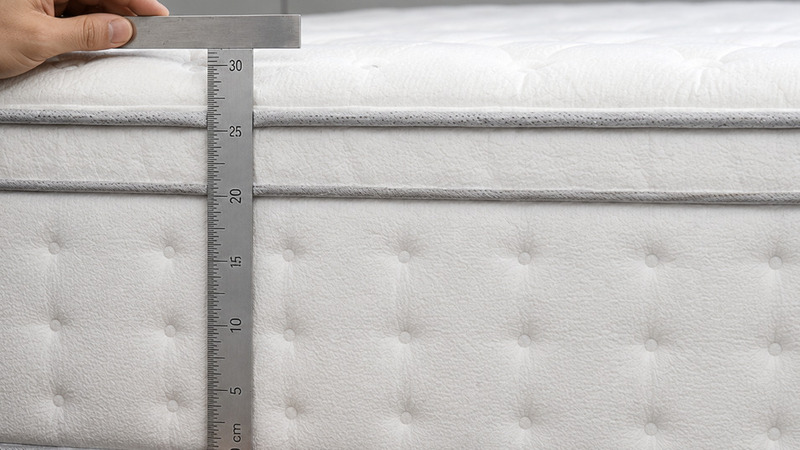
Confirm the actual mattress height, including any mattress pad, protector, or topper.
That number should set the finished pocket depth.
Allow for Shrinkage
A fitted sheet can fit well in the sample room and still pull loose after washing.
Before cutting, confirm whether the fabric has been pre-shrunk or tested for shrinkage.
This matters most for cotton fitted sheets and deep pocket fitted sheets.
Match the Elastic to the Order
Ask what elastic will be used and how well it recovers after washing.
For retail, online bedding, and private label fitted sheet programs, elastic recovery matters more than chasing the lowest unit cost.
Corner elastic can work on standard-height mattresses.
For thicker mattresses, frequent washing, or programs with little room for fit complaints, all-around elastic usually gives the sheet more margin.
Confirm the Sewing Details
Good elastic will not fix poor sewing.
Confirm the sewing tension and reinforced corner ends, not just the words “elastic included” on the spec sheet.
For me, the check is simple: get the mattress height right, allow for shrinkage, choose elastic with enough recovery, and make sure it is sewn correctly.That is where most fitted sheet fit problems are prevented.
Next Step for Bedding Buyers
Before your next fitted sheet order goes into production, send your supplier four details: target mattress height, expected washing conditions, market channel, and elastic requirement.
Those details make the spec much easier to control.
You can also review our related guide: Deep Pocket Fitted Sheets: 5 Spec Errors to Avoid.
At Dongyu Textile, we produce fitted sheets for B2B buyers, along with comforter sets, blankets, and seasonal bedding programs. We support OEM, ODM, and private label orders with practical spec checking before bulk production.
If you are planning a fitted sheet program, contact our bedding team with your target size, fabric, pocket depth, and market channel. We can help review whether the spec is ready for sampling or bulk production.