
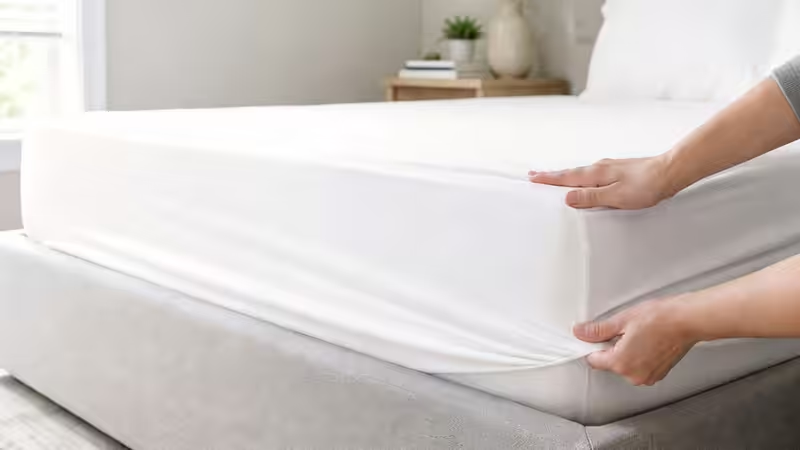
A fitted sheet can meet the approved measurements and still fit poorly on the mattress.
In more than 15 years of working with bedding products, I have seen the same five issues cause most fit problems: vague pocket-depth claims, incomplete mattress measurements, the wrong elastic setup, skipped post-wash testing, and an unfinished production specification.
This guide explains what buyers should check before approving deep pocket fitted sheets for bulk production.
It also includes two examples from actual orders where shrinkage and elastic performance affected the final fit.
Let’s start with the term that causes the most confusion.

Mistake 1: Treating “Deep Pocket” as a Standard Size
“Deep pocket” is a product description, not a fixed measurement.
Different brands and suppliers may use the term for fitted sheets with different pocket depths and fit ranges. Two sheets with the same label may not fit the same mattress.
Keep These Three Measurements Separate
A fitted sheet specification should distinguish between:
- Finished pocket depth
- Intended mattress height range
- Tested fit range
These measurements are related, but they are not interchangeable.
Finished pocket depth is usually measured along the corner seam. A 16-inch pocket does not automatically mean the sheet will fit every 16-inch mattress.
The final fit also depends on fabric stretch, elastic tension, dimensional change after laundering, and how much fabric extends under the mattress.
For that reason, the fit should be tested on the intended mattress profile rather than approved from the pocket-depth number alone.
Support Fit Claims with Testing
Any fit claim used on retail packaging or an online listing should be supported by the approved sample and documented fit testing.
A claim such as “fits mattresses up to 16 inches” should be based on an actual fit test, including a second test after laundering.
| Product Claim | What to Verify |
| Deep pocket | Finished pocket depth |
| Fits thick mattresses | Tested fit range |
| 16-inch pocket | Measurement method and post-wash depth |
| Stays in place | Elastic construction and fit-test results |
Once the fit range is clear, the next step is to make sure the mattress was measured correctly.
Mistake 2: Measuring Only the Bare Mattress
A fitted sheet often covers more than the mattress.
A topper, mattress pad, or padded protector can add enough height to change the fit. If those layers are not included, the finished sheet may be too shallow.
Measure the Mattress as the Customer Will Use It
Measure the bed with all regular layers in place.
The factory needs:
- Mattress length
- Mattress width
- Overall mattress height, including any topper or mattress pad
Measure from the bottom edge of the mattress to the highest point of the sleep surface. Do not press down on a pillow top or soft topper.
If the height varies, measure several points and provide a range. This is especially useful for retail and private-label programs designed to fit more than one mattress profile.
Check Length and Width by Size
Pocket depth gets most of the attention, but the top-panel dimensions matter just as much.
Twin and Twin XL mattresses have the same standard width, but a Twin XL is five inches longer. They require separate finished dimensions and cutting patterns.
Always confirm the buyer’s finished size specifications rather than relying on the size name alone.
Common measurement errors include:
- Leaving out a topper or mattress pad
- Measuring the foundation or bed frame
- Relying only on advertised dimensions
- Treating mattress height as pocket depth
The pattern needs enough fabric to cover the mattress sides and provide a secure allowance under the mattress.
For the first fit sample, provide the actual length, width, and overall height range. Those measurements are more useful than a size name or pocket-depth request alone.
Mistake 3: Choosing Elastic Based Only on Cost
Elastic has a direct effect on fitted sheet performance.
It influences how easily the sheet goes on, how firmly it grips the mattress, and whether it stays in place during use.
Full-Perimeter Elastic vs. Elastic Applied Only at the Corners
Full-perimeter elastic, also called all-around elastic, runs along the entire lower edge of the fitted sheet.
It distributes the holding force more evenly and gives the sides better support.
Some basic constructions use elastic only at the four corners. This can work for simpler mattress profiles and value-focused programs, but it provides less control along the sides.
The right construction depends on:
- Mattress height and profile
- Fabric weight and stretch
- Target price
- Required holding performance
For taller mattresses or programs that need a firmer hold, I normally start by testing full-perimeter elastic.
Width Alone Does Not Define Performance

Elastic width is only one part of the specification.
Placement, applied tension, and recovery after laundering also affect the fit.
If the tension is too high, the sheet may be difficult to install and the corners may distort. If it is too low, the sides may ride up or the corners may slip off.
| Elastic Construction | Main Benefit | What to Test |
| Full-perimeter elastic | More even hold around the mattress | Tension and recovery after laundering |
| Elastic at the corners only | Lower cost and simpler construction | Corner hold and side movement |
Elastic cannot correct an undersized sheet or a pocket that is too shallow.
The complete construction should be tested on the intended mattress before it becomes the production standard.
Mistake 4: Approving the Sample Before Laundering
A fitted sheet may fit well before washing and feel noticeably tighter afterward.
An unwashed sample shows the initial fit, but not how the fabric and elastic will perform after normal care.
Record the Initial Fit
Before laundering, record the finished length, width, and pocket depth.
Fit the sample on the intended mattress and check:
- Corner-seam position
- Side coverage
- Fabric allowance under the mattress
- Installation effort
- Top-panel tension
Take a full view, a side view, and a close-up of one corner. These photos provide a clear reference for the post-wash fit test.
Wash, Remeasure, and Refit
Wash and dry the sample according to the proposed care instructions.
Then measure it again, inspect the seams and corner shape, and check the elastic recovery. Refit the sheet on the same mattress.
The shrinkage percentage matters, but the final fit matters more.
The sheet should still go on without excessive force, cover the mattress correctly, and remain secure around the lower edge.

A Cotton Fitted Sheet That Became Too Tight
We once developed a 100% cotton queen fitted sheet for an online retailer.
The original sample fit the reference mattress, so the buyer approved it. After laundering, however, customers reported that the sheet felt tighter and was harder to pull over the corners.
Our follow-up test found approximately 4% shrinkage in the lengthwise, or warp, direction.
The sheet had met the original finished dimensions. The specification simply did not define the required fit after washing.
Since then, we have included a wash-and-refit test whenever dimensional change may affect a cotton fitted sheet. The pre-wash and post-wash results become part of the approved specification.
Mistake 5: Starting Production Without a Final Fit Specification
Product decisions often end up spread across emails, sample comments, measurement sheets, and meeting notes.
Before bulk production, those details need to be consolidated into one approved specification.
A physical sample shows the intended result. The written specification tells the production and quality teams how to reproduce it.
Use the Sample and Specification Together
Both should guide bulk production, in-line inspection, final inspection, and repeat orders.
| Specification Detail | What It Controls |
| Finished length and width | Overall mattress fit |
| Finished pocket depth | Side coverage and fabric allowance under the mattress |
| Measurement method and tolerance | Consistency across the order |
| Intended mattress height range | Intended product fit |
| Elastic type, width, and placement | How the sheet grips the mattress |
| Elastic performance reference | Consistency between elastic lots |
| Corner construction | Coverage and seam position |
| Pre-wash and post-wash dimensions | Dimensional change after laundering |
| Approved fit photos | Intended appearance on the mattress |
Before production starts, make sure the buyer, factory, and inspection team are working from the same revision.
I have seen problems occur because production followed an older measurement sheet while the buyer reviewed a newer sample. A revision number and approval date help prevent that.
An Elastic Change That Passed Visual Inspection
On one distributor order, the elastic supplier changed the rubber yarn without notifying us.
The replacement looked and felt similar to the approved elastic, but our comparison test showed approximately 15% lower elastic recovery. In practical terms, it did not return as strongly after stretching.
The finished sheets passed visual inspection. The weaker hold became clear only during the mattress fit test.
We now compare incoming elastic lots against the approved performance reference. Any lot outside the accepted range is held for review.
That experience changed the way we write elastic specifications. Width and appearance are not enough; performance also needs to be defined.
Quick Guide to Common Fitted Sheet Fit Problems
| Reported Problem | Likely Cause | Check First |
| Corners pop off after washing | Shrinkage or loss of elastic strength | Post-wash dimensions and elastic performance |
| Sheet looks loose or baggy | Pocket is too deep or tension is too low | Tested fit range and elastic specification |
| Sheet is difficult to install | Finished dimensions are too small | Pre-wash and post-wash measurements |
| Corners look twisted | Pattern or seams are misaligned | Corner construction and sewing |
| Fits before washing but not after | Dimensional change was not allowed for | Care method and post-wash fit |
| Edges move during use | Elastic coverage or recovery is insufficient | Elastic construction and fit-test results |
| One size fits but another does not | Each pattern was not checked separately | Size specification and cutting pattern |
Finalize the Fit Before Production
A deeper pocket does not guarantee a better fit.
Before releasing the order, make sure the approved sample and final specification agree on the mattress fit range, pocket depth, elastic construction, tolerances, and post-wash performance.
That gives the buyer, factory, and inspection team one clear standard to follow.
For available fabric and construction options, see our Fitted Sheet & Blanket Manufacturing page.
Need a Fitted Sheet Specification Review?
Dongyu Textile develops fitted sheets for retail, wholesale, and private-label programs.
Send us your required sizes, intended mattress height range, fabric specification, pocket depth, elastic construction, estimated order quantity, and packaging requirements.
We can review the details and identify any gaps before sampling or bulk production.