
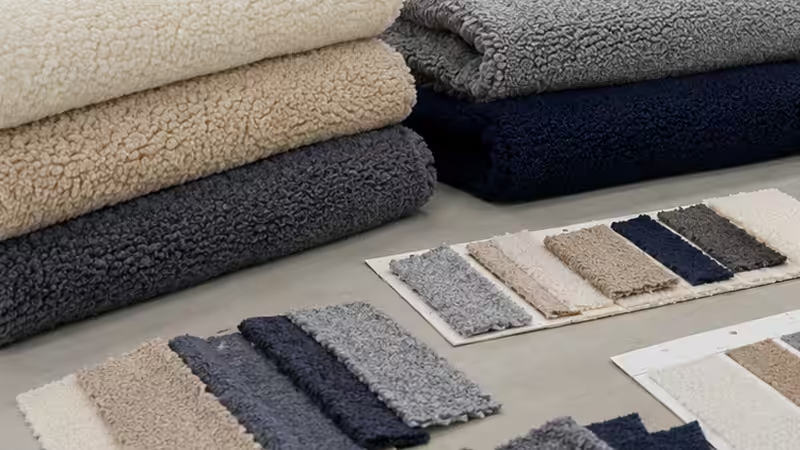
Trying to keep sherpa soft or stop fleece from pilling after a few washes? The right settings help, but they cannot fix a loose knit or unstable pile.
After 15 years in home-textile production, I have seen two 280 GSM fleece fabrics perform very differently. One showed visible pills by wash six; the tighter, sheared fabric kept a much more even surface after 20 home-laundering cycles.
This guide explains how to wash and dry sherpa and fleece blankets, deal with pilling or matting, and evaluate fabric before a bulk order.
Let’s start with what causes the problem.
Quick Answer
For most polyester sherpa and fleece blankets, wash in cold water—about 86°F (30°C) or below—on a Gentle or Delicate cycle with a small amount of mild liquid detergent. Give the blanket room to move, keep towels and rough items out of the load, and air-dry or tumble dry on low only when the care label allows it.
Why Do Sherpa and Fleece Blankets Pill or Mat?
Most people blame the washer when a sherpa or fleece blanket starts to pill or mat. Sometimes they are right, but the fabric may have been vulnerable before the first wash.
Care affects the result. Fabric construction sets the limit.
Pilling, Matting, and Shedding Are Different
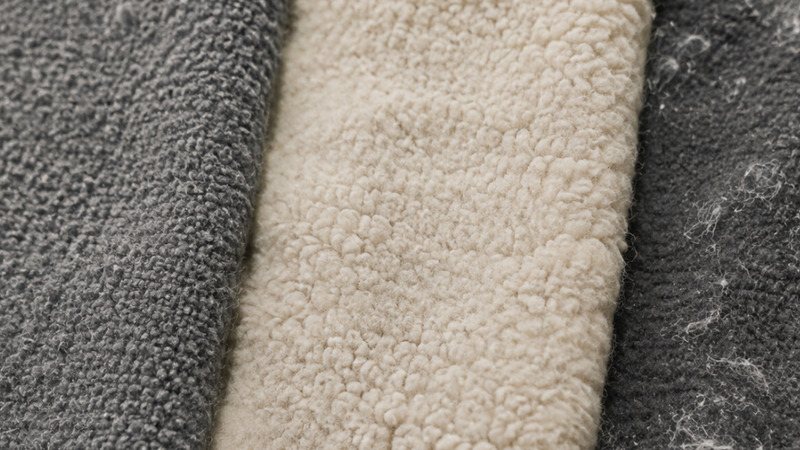
Pilling happens when loose surface fibers rub together and form small balls. It is most common on brushed fleece and other high-friction areas.
Matting happens when longer pile fibers flatten, twist, and clump together. You are more likely to see it on sherpa.
Shedding means loose fibers transfer to the washer, furniture, or other fabrics. Some early shedding can be normal, but continued fiber loss may point to an unstable surface.
The distinction matters. A fabric shaver may remove pills from smooth fleece, but it can damage a long sherpa pile.
Why Sherpa and Fleece Behave Differently
Sherpa has a longer, curled pile with a lambswool-like look. That raised surface adds warmth and softness, but it also catches lint and tangles more easily under heat, pressure, and friction.
Fleece usually starts with a knitted base that is brushed to raise the surface fibers. If those fibers are uneven or poorly anchored, repeated rubbing pulls them together into pills.
That is why knit density, brushing, shearing, loose-fiber removal, and anti-pill finishing matter as much as fiber content.
Why GSM Alone Does Not Predict Wash Performance
GSM measures fabric weight. It does not tell you how tight the knit is, how even the pile is, or how the surface will look after repeated laundering.
When we screen fleece for a bedding program, we also check the yarn, knit density, pile height, brushing, shearing, loose-fiber removal, and anti-pill finish.
What a 280 GSM Comparison Showed Us
During sampling, we compared two 280 GSM polyester fleece fabrics with the same fiber type but different construction and finishing.
| Item | Fabric A | Fabric B |
| Construction | Loose 12-gauge knit | Tighter 16-gauge double knit |
| Yarn and finish | Spun polyester; single brushing; unsheared pile | Polyester; 3 mm sheared pile; heat-set |
| Early result | Visible pills by wash six | Surface remained more even |
| After 20 cycles | Rough, matted patches in high-friction areas | Only scattered pills; pile stayed close to the approved look |
The fabrics had the same GSM and fiber type. The difference came from knit construction and finishing.
Best Wash Settings for Sherpa and Fleece Blankets
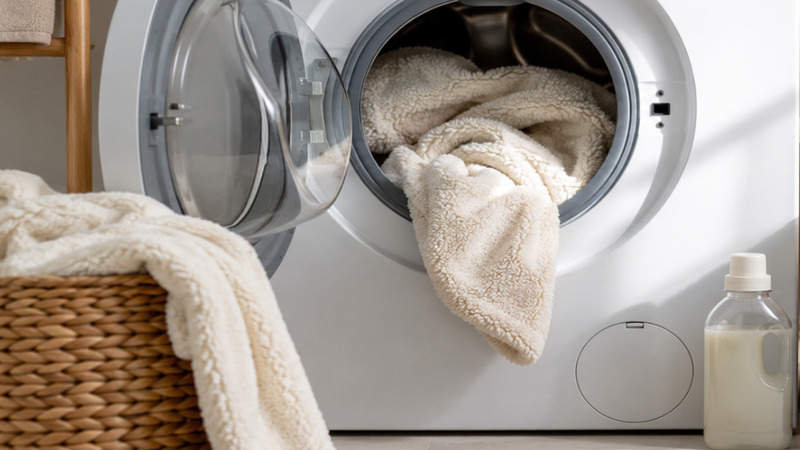
When buyers ask how to wash sherpa and fleece blankets without pilling, my answer is simple: use cold water, gentle movement, and enough room for the blanket to move.
The care label takes priority. Bonded constructions, decorative trims, and mixed-material blankets may need different settings.
Give the Blanket Room to Move
Do not pack a queen- or king-size blanket into a small washer. A tight load cleans unevenly and presses the pile against the drum and other items.
Use a large-capacity washer for oversized bedding. The blanket should turn freely without being forced into the machine.
What Temperature Should You Wash Fleece At?
For most polyester sherpa and fleece blankets, cold water at about 86°F (30°C) or below is a practical starting point.
Hot water can make matting, roughness, and color loss more noticeable. For a small stain, work a little mild detergent into the spot before washing instead of raising the water temperature.
Use a Gentle Cycle and Mild Detergent
Choose the shortest Gentle or Delicate cycle that gets the blanket clean. If the washer has an adjustable spin speed, use Low Spin.
Use a small amount of mild liquid detergent. Too much can stay in the pile and leave the blanket stiff or dull.
Avoid chlorine bleach and harsh cleaners. Skip fabric softener unless the care label allows it, since residue can build up in the pile.
Keep Rough Fabrics Out of the Load
Wash sherpa and fleece blankets separately when possible. Similar lightweight synthetic bedding can share the load if it has no zippers, hooks, or rough trims.
Avoid bath towels, denim, heavy cotton bedding, and hook-and-loop fasteners. They add abrasion, lint, or both.
A fleece blanket washed with towels may come out covered in cotton lint even when the fleece itself is not shedding.
Wash Settings Quick-Reference Table
| Care Setting | Recommended Starting Point |
| Water temperature | Cold, about 86°F (30°C) or below |
| Wash cycle | Gentle or Delicate |
| Spin speed | Low, when adjustable |
| Wash load | Separate or with similar soft items |
| Detergent | Small amount of mild liquid detergent |
| Fabric softener | Avoid unless the care label allows it |
These settings are a practical baseline for common polyester constructions. The product care label should reflect the tested finished item.
How to Dry Sherpa and Fleece Without Pilling or Matting
A careful wash can be undone by too much dryer heat. To keep sherpa soft after washing, use a low temperature and stop as soon as the blanket is dry.
Air-Dry or Tumble Dry on Low
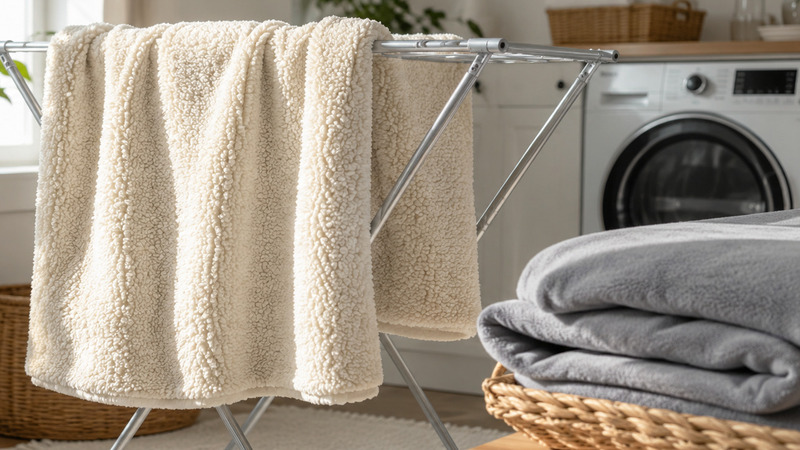
Air-drying is the safer choice for long-pile sherpa or a surface that already feels loose. Lay the blanket flat or support it evenly on a drying rack so the weight is spread out.
Make sure the blanket is fully dry before folding or storing it.
Many polyester sherpa and fleece blankets can be tumble-dried when the care label allows it. Use Low Heat, Air Fluff, or No Heat, and remove the blanket promptly.
Avoid High Heat and Over-Drying
Low heat and a short drying time are easier on the pile than a fast cycle at high heat.
Do not leave the blanket in a hot drum or run another full cycle for a few damp spots. Let those areas finish air-drying.
Keep wet sherpa away from radiators and space heaters. Direct heat can flatten the pile and leave it rough.
Use Dryer Balls With Care
Dryer balls can help bulky bedding move more freely and dry more evenly. They are useful, but not essential.
The extra tumbling may be too much for long-pile sherpa or fleece with loose surface fibers. Heat, drying time, and tumbling matter more than dryer balls.
How to Remove Fleece Pilling or Improve Matted Sherpa
Fleece pills and matted sherpa need different tools. A fabric shaver works on smooth fleece, while sherpa needs a much lighter touch.
Use a Fabric Shaver on Smooth Fleece
Make sure the blanket is completely dry and place it on a flat surface. Test the shaver in a hidden area, then use light pressure and short passes.
Avoid seams, binding, embroidery, and thin or worn areas. A fabric shaver removes loose surface fibers, but it does not restore the original anti-pill finish.
Use a Soft Brush on Matted Sherpa
Remove hair, lint, and loose debris first. Lay the blanket flat and test a soft-bristle fabric brush in a low-visibility area.
Work in small sections and follow the direction of the pile. Gentle brushing can improve light matting, but heat-damaged fibers may not return to their original texture.
Avoid Repairs That Damage the Pile
Do not pull pills by hand or use a disposable razor. Both can cut yarns and leave uneven spots.
Avoid stiff brushes, repeated shaving on the same area, ironing the pile, or using high heat to bring back softness. These methods usually create more damage than they fix.
What Bulk Buyers Should Check Before Ordering
For bulk orders, a soft sample is not enough. What matters is how the bedding looks after laundering and whether the production run matches the approved specification.
At Dongyu Textile, we focus on fabric construction, verified test results, and fit for the sales channel before approving sherpa or fleece bedding for production.
Look Beyond GSM
GSM is useful for comparing weight and cost, but it is not a stand-alone quality grade.
Buyers should also confirm the fiber composition, knit density, pile height, brushing and shearing, bonded or unbonded construction, anti-pill finish, and appearance after laundering.
Ask for Clear Test Results
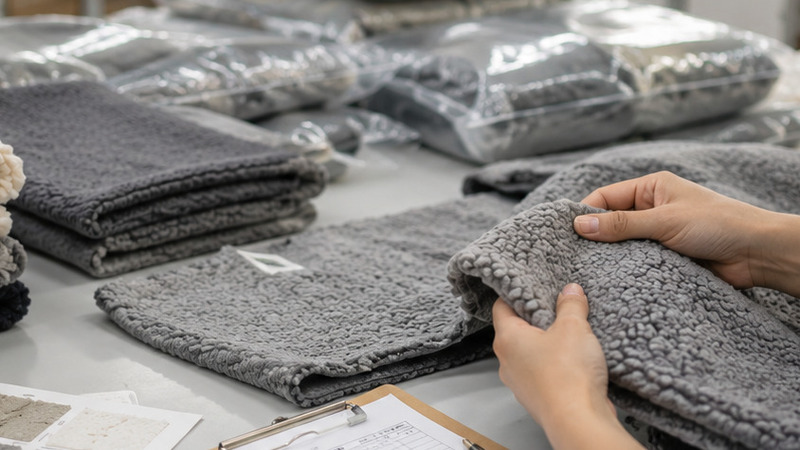
“Anti-pill” should be backed by a defined test method and an agreed acceptance level.
At Dongyu Textile, we use an internal protocol adapted from ISO 12945-2:2020. We rate the fabric after 2,000 Martindale rubs, then run five in-house wash-and-dry cycles to check pilling, matting, and changes in hand feel.
The abrasion result must be grade 4 or better on our 1-to-5 visual scale, with 5 being the best. After laundering, the sample must stay close to the approved standard in pile appearance and hand feel.
We screen raw fabric before production and inspect finished blankets before shipment.
Development samples should use the confirmed bulk-quality fabric and finishing process; final verification pieces come directly from the finished production lot.
Anything outside either limit is rejected before shipment.
Match the Product to the Sales Channel
| Sales Channel | Main Priority |
| Value retail | Workable cost, softness, and acceptable wash appearance |
| E-commerce | Consistent hand feel, visual consistency, and lower return risk |
| Hospitality | Repeat-laundering performance and lot-to-lot consistency |
| Private label | Fabric specifications, sizing, binding, labels, and packaging |
The right specification is not always the highest GSM. It is the one that fits the target price, performs for the intended channel, and stays consistent from sample approval through bulk production.
Looking for Pilling-Resistant Sherpa or Fleece Bedding?
Dongyu Textile develops value-focused sherpa and fleece bedding for retail, wholesale, hospitality, seasonal, and private-label programs. With 15+ years in home-textile production, we support OEM and ODM projects from fabric selection and sampling through care labeling, packaging, and bulk production.
Send us your target construction, GSM, size, color, packaging, and wash-test requirements. We will review the specification before sampling, so cost, performance, and production details are clear from the start.