
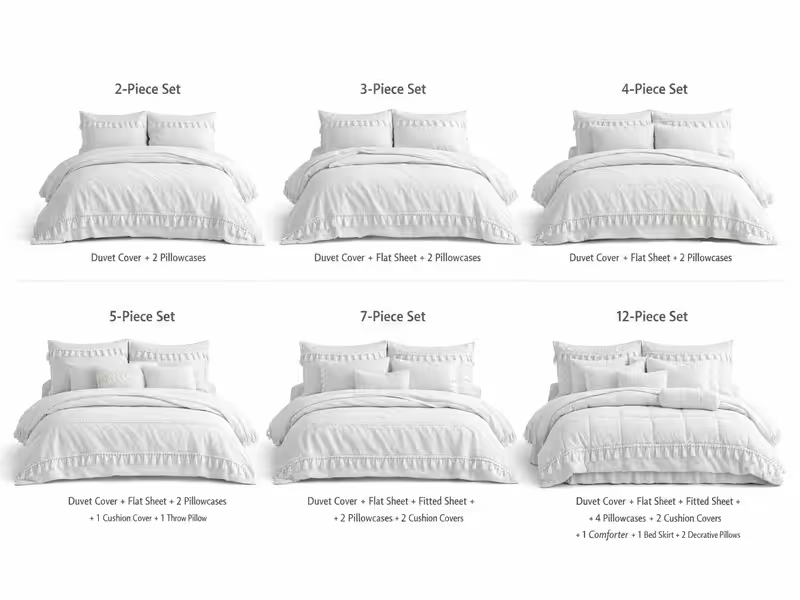
Choosing the right bedding set configuration is not only a product decision. For importers, wholesalers, retailers, and private label brands, it also affects price positioning, packaging efficiency, freight cost, inventory planning, and reorder potential.
From simple duvet cover sets to larger bed-in-a-bag programs, bedding can be offered in many formats. But not every configuration works equally well in every market. A set that sells well in one region may not perform the same way in another.
If you want to build a bedding program that is easier to sell, easier to ship, and easier to reorder, the set configuration should be planned around market demand rather than personal preference or supplier habit.
If you want to choose the right bedding set configuration for your market, start with customer demand, regional size standards, price positioning, and shipping efficiency. For B2B buyers, the best bedding set is not always the one with the most pieces, but the one that best matches the target market, packaging requirements, and reorder potential.
Why Bedding Set Configuration Matters
When buyers source bedding, they often focus first on fabric, color, print, or price. These are important, but the bedding set configuration is just as important because it shapes how the product is sold and how the value is perceived.
The right bedding set configuration can help you:
- match local market expectations
- improve price-to-value perception
- simplify packaging and shipping
- reduce inventory mismatch
- support more stable repeat orders
The wrong configuration can lead to confusion over set contents, weak retail positioning, and slow-moving stock. That is why experienced B2B buyers usually evaluate bedding by both product quality and configuration structure.
What Is a Bedding Set Configuration?
A bedding set configuration refers to the number of pieces included in a bedding set and the combination of products packed together.
A bedding set may include items such as:
- duvet cover
- fitted sheet
- flat sheet
- pillowcases
- comforter
- shams
- decorative cushions
- bed skirt
However, one important fact is that bedding set configurations are not fully universal. A 5-piece or 7-piece set may include different items depending on the market, retailer, and program requirement.
For wholesale orders, it is always safer to confirm the exact contents and dimensions of the set instead of relying only on the piece count.
Common Bedding Set Configurations in International Markets
Below are some of the most common bedding set configurations used in wholesale and retail programs. These are typical examples rather than fixed global rules.
2-Piece and 3-Piece Duvet Cover Sets
These sets usually include:
- 1 duvet cover
- 1 or 2 pillowcases
This format is common in many European and some Asian markets. Because these sets do not include bulky filling, they are generally easier to pack, store, and ship than comforter-based sets.
Best for:
- online retail
- duvet-cover markets
- seasonal printed collections
- private label brands looking for flexible packaging
3-Piece and 4-Piece Sheet Sets
These sets commonly include:
- 1 fitted sheet
- 1 flat sheet
- 1 or 2 pillowcases
In many North American bedding programs, 4-piece sheet sets are one of the most widely used formats. They are practical, easy to understand, and suitable for both household retail and hospitality supply.
Best for:
- wholesalers
- importers
- chain retailers
- hospitality supply programs
5-Piece to 7-Piece Comforter Sets
These sets are often designed to create a more complete bed presentation. Depending on the program, they may include:
- 1 comforter
- 2 shams
- decorative cushions
- a bed skirt
The exact combination can vary from one retailer or market to another, so buyers should always confirm the full packing list before sampling or production.
Best for:
- mid-range retail collections
- discount retail
- buyers looking for stronger display value
- programs that need better visual presentation
8-Piece to 12-Piece Bed-in-a-Bag Sets
These larger bedding sets combine comforter-based components with more sheet or decorative items. A typical set may include:
- 1 comforter
- 2 shams
- 1 fitted sheet
- 1 flat sheet
- 2 pillowcases
- 1 bed skirt or decorative accessory
Higher piece-count sets may also include extra cushions, Euro shams, or other decorative items. These programs offer strong perceived value, but they also require closer control over carton size, shipping cost, and warehouse space.
Best for:
- big-box retail
- promotional programs
- shelf-impact collections
How Bedding Set Sizes Differ by Market
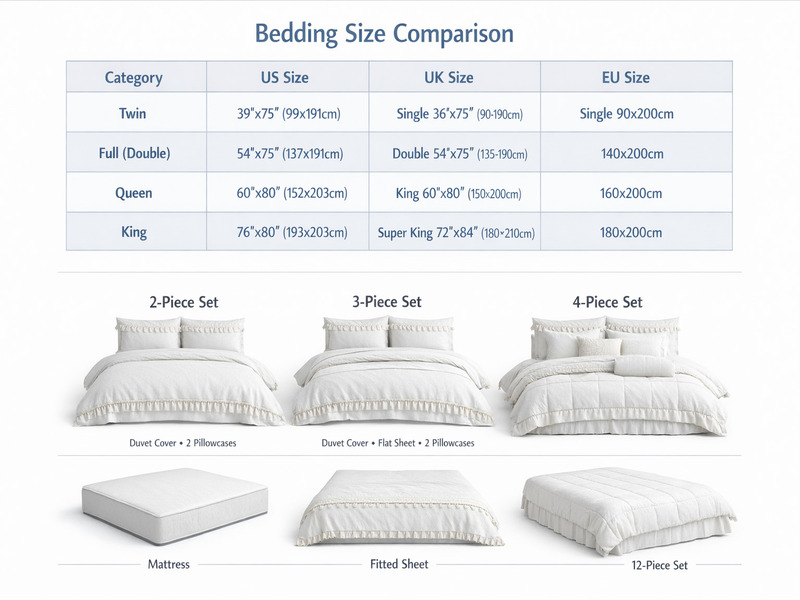
One of the most common sourcing mistakes is assuming that bedding size names mean the same thing everywhere.
Terms such as Twin, Full, Queen, King, Double, and Super King are not fully standardized across all countries. Even when two size names look similar, the actual dimensions may still differ.
This matters because the wrong size specification can cause:
- poor mattress fit
- customer complaints
- production mistakes
- higher return risk
- mismatch with local market expectations
When placing a wholesale bedding order, always confirm:
Mattress Dimensions
Make sure the sheet size is built around the exact mattress measurements used in the destination market.
Fitted Sheet Pocket Depth
Pocket depth is especially important for modern thicker mattresses. A good-looking fitted sheet can still fail if the depth is wrong.
Duvet or Comforter Size
The outer dimensions of duvet covers and comforters should match local bedding habits and insert standards.
Pillowcase and Sham Size
Pillow sizes differ by market, so this part should never be assumed.
Inch and Centimeter Measurements
For international orders, exact measurements are more reliable than size names alone.
Standard Bedding Sets vs Custom Bedding Sets
Standard bedding sets are useful for general retail, but more buyers now prefer custom bedding sets that fit their own market strategy.
Custom bedding sets allow buyers to adjust:
- piece count
- product combination
- size specifications
- fabric type
- print design
- packaging format
- private label details
For example, one buyer may need a simple 3-piece duvet cover set for e-commerce, while another may want an 8-piece bedding bundle for in-store display. In both cases, the right answer depends on the sales channel and customer demand.
This is why custom bedding sets are becoming more important for importers, distributors, and private label brands that want better assortment control, more accurate pricing, and less inventory pressure.
How to Choose the Right Bedding Set for Your Business
There is no single bedding set configuration that fits every market. The best choice depends on your business model, sales channel, target price range, and end-customer expectation.
For E-commerce Bedding Programs
Online selling usually works better with products that are easier to fold, pack, store, and ship. Lightweight sets are often more efficient than bulky filled products.
Recommended options:
- duvet cover sets
- sheet sets
- lightweight blankets
- compact packaging formats
For Importers and Distributors
Importers and distributors usually need products that can work across different accounts and customer types. Flexibility and reorder stability are often more important than high piece count.
Recommended options:
- standard sheet sets
- practical comforter programs
- customizable size and piece-count combinations
For Retail Chains and Big-Box Stores
Physical retail usually places greater value on shelf appeal and complete bed presentation. Larger sets can create stronger perceived value when they are planned around the right price point.
Recommended options:
- 7-piece to 12-piece bedding programs
- bed-in-a-bag collections
- retail-ready packaging with clear labeling
For Hospitality and Institutional Supply
Hotels, motels, and institutional buyers usually prefer practical, durable, and easy-to-replace bedding products instead of decorative retail bundles.
Recommended options:
- fitted sheets
- flat sheets
- pillowcases
- blankets
- simple standardized sheet sets
3 Practical Tips Before Ordering Wholesale Bedding Sets
1. Confirm the Exact Set Contents
Do not assume that a 5-piece, 7-piece, or 8-piece set means the same thing in every market. Always confirm the full product combination before production.
A clear packing list helps avoid confusion, reduce sampling mistakes, and improve order accuracy.
2. Check Packaging and Shipping Early
Larger bedding sets may look attractive in retail, but they can also increase storage and freight costs. Depending on the construction and presentation requirement, vacuum packing or other space-saving packaging methods may help improve shipping efficiency.
Before final approval, review:
- unit pack size
- carton dimensions
- loading efficiency
- shipping cost per set
- warehouse storage requirements
3. Match the Set to Your Market Position
A bedding set should support your target market, not just offer more pieces. A simpler set with better product-market fit may sell more consistently than a larger bundle that creates confusion or unnecessary cost pressure.
Choose the configuration that helps your customers buy more confidently and reorder more easily.
FAQs About Bedding Set Configurations
What is the most common bedding set configuration?
There is no single global standard, but 3-piece duvet cover sets, 4-piece sheet sets, and bed-in-a-bag programs are among the most widely used bedding formats in different markets.
Do all bedding sets include a comforter?
No. Duvet cover sets and sheet sets usually do not include filled comforters or duvet inserts. Comforter sets and bed-in-a-bag programs are more likely to include filled items.
Can I order custom bedding sets for my market?
Yes. Many B2B buyers customize the piece count, size, fabric, print, packaging, and label details to match their target market and business model.
Why do bedding sizes vary by country?
Different markets use different mattress standards and naming systems. That is why exact measurements should always be confirmed before production.
Final Thoughts
The best bedding set configuration is the one that matches your market, your price target, and your sales channel.
For B2B buyers, successful bedding programs are usually built around real demand, practical packaging, and clear reorder logic. A well-planned bedding set can improve sell-through, reduce freight pressure, and support more stable repeat business.
If you are developing a wholesale bedding program, it is better to build the product structure around what your market actually needs than to rely on fixed set formats that may not fit your customers.
Looking for Custom Bedding Set Solutions?
We support importers, wholesalers, distributors, and private label brands with flexible bedding set development based on real market needs.
From duvet cover sets and sheet sets to comforter programs, fitted sheets, blankets, and custom bundle configurations, we help you create bedding products with the right size, right piece count, and right packaging for your business.
Contact us to discuss your target market, preferred bedding configuration, and product requirements.