

Knowing how to put sheets on a bed is not only about getting the layers in the right order. The bedding also needs to fit the mattress properly and stay secure through regular use.
In bedding production, many problems that look like bed-making mistakes turn out to be fit or construction issues. A fitted sheet may not match the mattress depth, a flat sheet may not have enough fabric to stay tucked, or a duvet insert may have too much room inside the cover.
This article covers fitted-sheet fit, flat-sheet positioning, hospital corners, and duvet or comforter stability. It also explains what to check when bedding loosens, wrinkles, or feels tighter after washing.
Start with mattress depth, because a fitted sheet cannot stay secure if its pocket depth does not suit the mattress.
Fitted Sheet Fit: Match Mattress Depth and Pocket Depth
A fitted sheet should sit smoothly on the mattress without excessive tension or loose fabric. When we review fit problems, one of the first things we check is the relationship between mattress depth and pocket depth. If those measurements do not work together, changing the way the sheet is put on will only help so much.
Measure Mattress Depth Before Choosing a Fitted Sheet
Twin, Full, Queen, and King describe mattress length and width, but they do not tell you whether the fitted-sheet pocket is deep enough.
Measure from the bottom of the mattress to the top sleeping surface, including any topper, pad, or protector that stays on the bed. If the corner seams pull upward, the elastic barely reaches under the mattress, or the last corner is difficult to secure, the pocket depth may be too shallow.
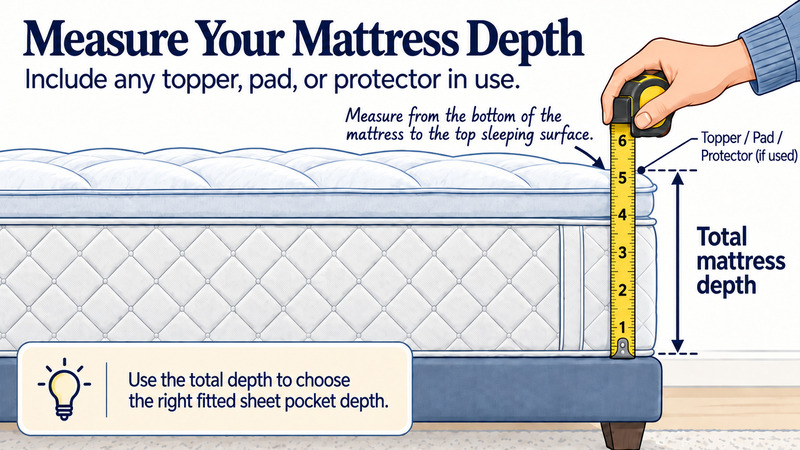
Match Fitted Sheet Pocket Depth to Mattress Height
Deep-pocket sheets are made for thicker mattresses, but a deeper pocket is not always a better fit. The useful specification is the one that matches the intended mattress range and leaves enough fabric to sit securely under the mattress.
A pocket that is too shallow creates excess tension and makes the corners more likely to come loose. A pocket that is too deep can leave extra fabric on a thinner mattress and reduce the clean, fitted appearance buyers expect.
When we develop fitted sheets, we look at mattress height, fabric behavior, and elastic performance together. That combination matters more than the pocket-depth label alone when the goal is consistent fit and stability.
How to Put On a Fitted Sheet for a Secure Fit
Once the fitted sheet matches the mattress, setup becomes much easier. Direction and corner tension still matter, especially on thicker mattresses where a small alignment error can make the last corner feel much tighter than the others.
Check Fitted Sheet Orientation Before Securing the Corners
Lay the fitted sheet over the mattress and confirm the direction before pulling the elastic underneath. The shorter sides should align with the head and foot of the bed, while the longer sides follow the mattress length.
Some fitted sheets use Top, Bottom, Long Side, or Short Side labels to make orientation easier. Care tags may also help, but their placement varies by construction, so the shape and seam positions are a more reliable check.
Balance Corner Tension When Putting On a Fitted Sheet
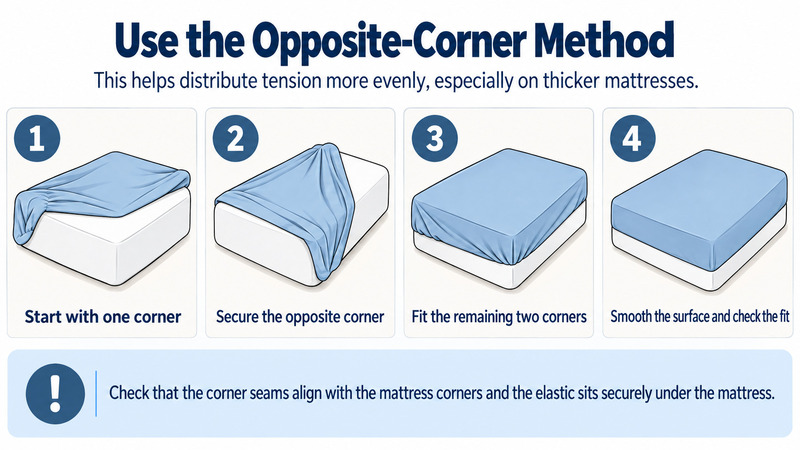
Secure one corner, then move to the opposite corner before fitting the remaining two. Working diagonally helps distribute tension across the sheet instead of loading one side first.
After all four corners are on, check that the elastic sits under the mattress rather than riding up the sides. This is especially useful with taller mattresses, where uneven tension can quickly pull a corner loose.
Why Fitted Sheets Come Off the Mattress
If a fitted sheet slips from the start, check mattress depth, pocket depth, orientation, and corner alignment. If it fits well when new but becomes less secure after repeated laundering, elastic recovery and fabric shrinkage may be part of the problem.
Sheet straps can add support, but they should not be the first fix for a basic size mismatch. In product development, we treat straps as a secondary feature after pocket size, elastic construction, and expected wash performance are aligned with the intended mattress range.
Fitted Sheet Wrinkles: Fabric Construction and Wash Performance
A fitted sheet can be the right size and still look less smooth than expected. Once fit and setup are correct, fabric construction and wash performance become the next things to consider.
Smooth the Fitted Sheet Before Looking for a Fabric Issue
After putting on the fitted sheet, smooth the surface from the center of the mattress toward the edges. This removes normal surface creases and helps the corner seams settle into position.
If wrinkles return quickly, the fabric may simply have a crisper hand or less drape. That is different from a size problem, and pulling the sheet tighter will not necessarily improve the appearance.
Percale vs. Sateen: Different Drape and Surface Appearance
Percale usually has a crisp, matte feel and a more structured appearance. Sateen tends to feel smoother and drape more softly across the mattress. Neither construction is automatically better; they suit different product positions and customer expectations.
For a bedding buyer, the useful question is not only how the fabric feels when new, but how it looks and fits after normal laundering. Two fabrics with the same finished size can behave differently after repeated washing, so wash performance is worth reviewing during sample approval.
Why Fitted Sheets Can Feel Tighter After Washing
A fitted sheet that fits well when new may feel tighter after repeated laundering. One factor is dimensional stability, which describes how well the fabric maintains its intended length and width after washing and drying.
This is a measurable textile-performance issue. AATCC TM135 is specifically designed to determine dimensional changes in fabrics after standardized home laundering procedures.
Independent bedding testing looks at the same performance areas. The Good Housekeeping Institute reports testing more than 350 sheet sets and evaluates factors including shrinkage, wrinkle resistance, and mattress fit using industry-standard methods such as AATCC 135. Good Housekeeping Institute bed-sheet testing methods.
For production, that is why shrinkage control and finishing matter. Fabric density, weave, yarn selection, and finishing can all influence drape, smoothness, and long-term fit. Equal size labels do not always mean equal performance after repeated use and care.
How to Put On a Flat Sheet and Keep It Tucked
Unlike a fitted sheet, a flat sheet does not attach to the mattress. It stays neat through good positioning, even overhang, and enough fabric at the foot of the bed to create a secure tuck.
In the U.S. market, a flat sheet is optional. Some sheet sets include one as a standard layer, while other bedding setups use a fitted sheet with a removable, washable duvet cover.
Position the Flat Sheet Before Tucking
If the flat sheet has a printed, embroidered, or clearly finished face, place that side down when you spread it over the bed. When the top edge is folded back, the finished side will face up.
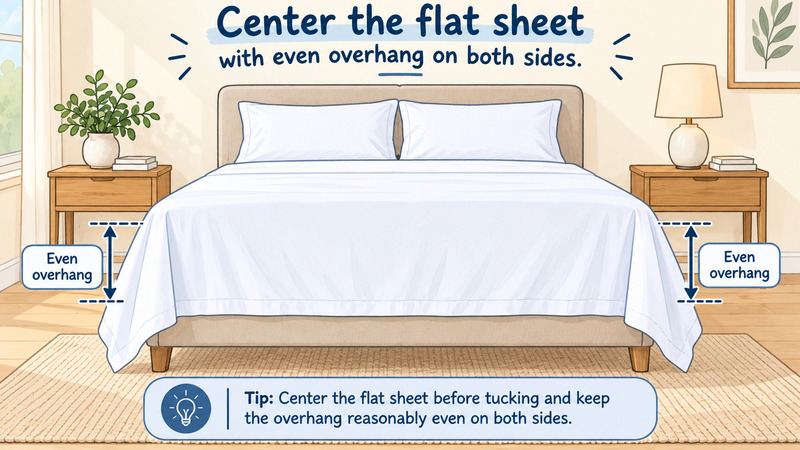
Center the sheet before tucking it. Keep the drop on both sides reasonably even and leave enough length at the foot of the bed to hold under the mattress without pulling the top edge out of position.
Make Hospital Corners for a Cleaner, More Secure Tuck
Hospital corners help control loose fabric at the foot of the bed and give the flat sheet a cleaner finish. The basic process is simple:
- Tuck the sheet under the mattress across the foot of the bed.
- Lift the loose side fabric and form a clean diagonal fold.
- Tuck the lower section under the mattress.
- Bring the folded section down and secure the remaining edge.
Why Hospital Corners Help the Flat Sheet Stay in Place
A hospital corner creates a more controlled tuck than simply pushing loose fabric under the mattress. It is useful in hospitality, retail presentation, and everyday bedding when a neat, stable flat sheet is the goal.
Comforter Bunching: Duvet Fit, Corner Ties, and Quilting
Comforter bunching can come from two different places. The duvet insert may shift inside the cover, or the filling may move inside the comforter itself. They can look similar on the bed, but the checks are different.
When we review a sample with uneven areas, we separate those two problems before changing the construction. A cover-fit problem will not be solved by changing the quilting, while a fill-distribution problem will not be solved simply by adding more ties.
Match Duvet Insert and Cover Dimensions
A stable duvet setup starts with compatible insert and cover dimensions. Full/Queen or King/Cal King labels are useful references, but actual finished measurements give a clearer picture of how much room the insert has inside the cover.
If the cover is noticeably larger than the insert, the extra space can allow the insert to shift, leaving empty corners or uneven areas. For a more stable fit, compare the finished length and width of both pieces rather than relying on the size label alone.
Once the dimensions are reasonably matched, check how the insert is secured inside the cover.
Use Corner Ties to Limit Duvet Insert Movement
Corner ties or loops help secure the duvet insert to the cover and reduce shifting during use. They are especially useful on larger sizes, where movement is easier to notice. Some duvet covers also use side attachment points when additional stability is needed.
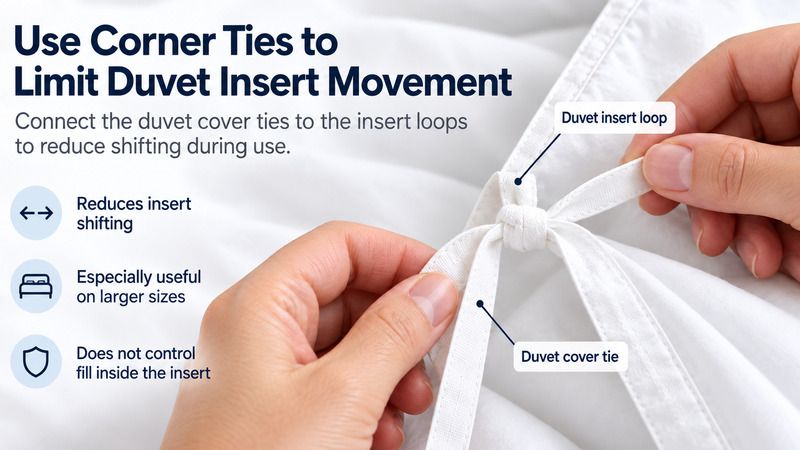
These attachment points only control movement between the insert and cover. If the insert stays in place but the comforter still develops lumps or uneven areas, the next thing to check is the fill distribution and quilting construction.
Comforter Quilting and Fill Stability
For filled comforters, we look for a balance between softness, loft, and fill stability. The product should feel comfortable, but the filling also needs enough control to remain reasonably even during use and care.
Quilting divides the comforter into sections and limits how far the filling can move. The right quilting pattern depends on fill type, fill weight, comforter size, loft, and intended product position. There is no single pattern that suits every comforter.
A useful distinction is simple: corner ties help control the duvet insert inside the cover, while quilting helps control the filling inside the comforter.
How to Put Sheets on a Bed: Quick Checks for Common Fit Problems
When something still looks wrong after the bedding is on, I usually start with the visible symptom and work back to the likely fit or construction issue. This table gives you a practical place to begin without repeating the full troubleshooting process.
| What You Notice | What to Check First |
| Fourth fitted-sheet corner will not reach | Mattress depth and pocket depth |
| One side feels noticeably tighter | Sheet orientation and corner alignment |
| Fitted sheet comes off overnight | Pocket fit and elastic recovery |
| Fitted sheet feels tighter after washing | Dimensional stability |
| Flat sheet keeps pulling loose | Centering and tuck depth |
| Duvet cover has empty corners | Insert-to-cover dimensions and corner ties |
| Comforter develops uneven or lumpy areas | Fill distribution and quilting |
How to Put Sheets on a Bed: Frequently Asked Questions
What Is the Correct Order for Putting Sheets on a Bed?
Start with a mattress protector or pad if you use one, followed by the fitted sheet, optional flat sheet, optional blanket, comforter or duvet, and pillows.
How Do I Know if a Fitted Sheet Is Too Shallow?
Check the corners. If the seams sit above the mattress corners, the elastic barely reaches underneath, or one corner comes off while you secure another, the pocket depth is likely too shallow.
Do I Need a Flat Sheet With a Duvet or Comforter?
No. A flat sheet is optional. Some bedding setups use one between the sleeper and the comforter or duvet, while others use a fitted sheet with a removable, washable duvet cover.
Why Does a Duvet Still Bunch With Corner Ties?
Corner ties keep the duvet insert connected to the cover, but they do not control filling inside the insert. If the insert stays in position and lumps still form, check the fill distribution and quilting construction.
How to Put Sheets on a Bed: Final Fit Check
Knowing how to put sheets on a bed helps rule out most setup issues. If the bedding still slips, feels tight, or bunches after it is fitted correctly, the next thing to review is the product specification or construction.
For B2B buyers, Dongyu Textile supports fitted sheets, comforter sets, blankets, and private-label bedding programs. If you are developing a bedding line, send us your requirements for size, fabric, quantity, and packaging. We can review the specifications and support sampling before bulk production.