
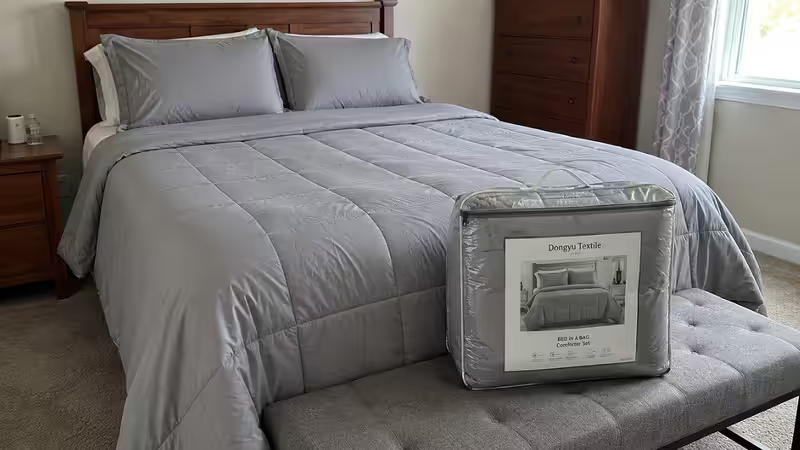
Buying bed in a bag comforter sets in bulk looks simple at first.
Most problems start with small details.
A set may look good in photos, but the fitted sheet may not fit the target mattress. The comforter may lose loft after packing. The packaging may not fit the sales channel.
In bedding production, we often see these issues when specs, samples, labels, and packing details are not confirmed early.
This guide walks through the main checks before bulk production: set structure, size, fabric, fill, design, packaging, labels, carton details, and sample approval.
Let’s start with what goes into a bed in a bag set.
What Is a Bed in a Bag Comforter Set?
A bed in a bag comforter set is a pre-packed bedding set built around a comforter.
It usually brings together the main bedding pieces for one bed in one coordinated package.
For buyers, this makes the program easier to plan.
Retailers can sell one complete set under one SKU.
It also reduces the work of sourcing each item separately. Online sellers can present a clearer product offer. Hotels, rental programs, dorm projects, and apartment projects can keep the same bedding setup across many rooms.
Instead of managing the comforter, sheet set, pillow pieces, labels, packaging, and cartons separately, buyers can manage them as one program.
That is why bed in a bag comforter sets are common in retail, online, wholesale, hospitality, rental, and private label bedding programs.
What Comes in a Typical Bed in a Bag Set?
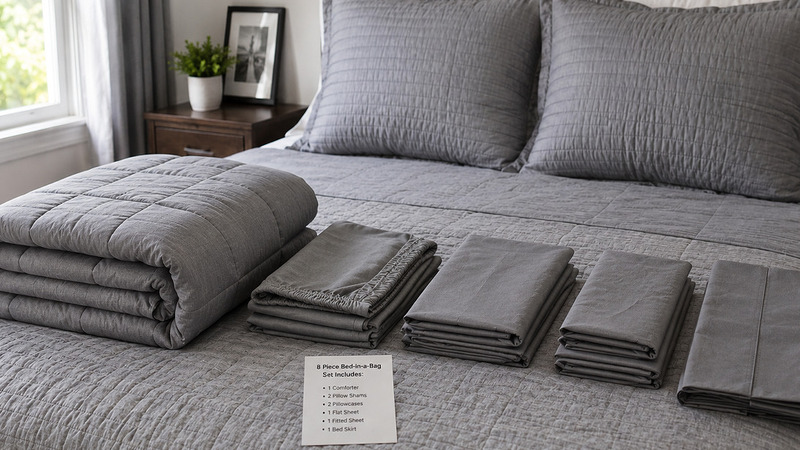
Most bed in a bag sets start with comforter sets.
Then buyers add sheets and pillow pieces based on the target price, bed size, and sales channel.
Common pieces include:
- Comforter
- Fitted sheet
- Flat sheet
- Pillowcases
- Pillow shams
Some sets may also include a bed skirt, decorative pillow, blanket, or other matching pieces.
More pieces do not always mean a better set.
A value-focused online program may only need a simple 5-piece or 6-piece set. A retail shelf program may need 7 pieces or more to create a fuller bedroom look.
The right structure depends on the price point, packing size, sales channel, and how the bedding will be used.
Match the Set Structure to the Sales Channel
The set structure should match how the product will be sold, packed, shipped, and used.
An online program may not need the same piece count as a retail shelf program.
A hospitality or rental program may need fewer decorative pieces and stronger wash performance.
Retail Programs
Retail buyers usually want the set to look complete on the shelf.
A 7-piece or larger set may include a comforter, fitted sheet, flat sheet, pillowcases, shams, and sometimes a bed skirt or decorative pillow.
The package should be clear at a glance.
Piece count, size, color name, product image, barcode, and key details should be easy to find.
For retail programs, the set should be easy to display, compare, and buy.
Online Programs
Online programs need a set that is easy to show in photos and product listings.
A 5-piece or 6-piece set often works well when price, carton size, and shipping weight are important.
The listing should show exactly what is included.
Customers should not have to guess whether sheets, pillowcases, or shams are inside the package.
Compact packing or vacuum packing can help reduce carton volume.
But the sample should be opened and checked before approval. The comforter still needs to recover its loft after packing.
Wholesale Programs
Wholesale buyers usually focus on stable cost, simple packing, and repeatable specs.
Some buyers want a full bed in a bag program. Others prefer to keep the comforter set and sheet set separate, so they can mix sizes, colors, or price points.
For wholesale orders, carton size, packing quantity, pallet loading, and repeat order consistency should be confirmed early.
These details affect cost, warehouse handling, and future reorders.
Hospitality, Rental, and Dorm Programs

Hospitality, rental, and dorm programs usually need bedding that is simple, durable, and easy to manage.
White, gray, beige, and other light neutral colors are common because they work across different room styles.
For these orders, buyers should check fitted sheet pocket depth, stitching, wash performance, size consistency, and fabric durability.
If the bedding will be washed often, the sample should be washed before final approval.
Private Label Programs
Private label buyers often need more control over the final product.
They may adjust piece count, fabric, color, stitching, labels, insert cards, barcodes, packaging artwork, and carton marks.
These details should be confirmed before the final sample is approved.
Once bulk production starts, even small label or packaging changes can add cost.
Choose the Right Size Range and Fit Details
Size names are only the starting point.
A Queen set still needs confirmed finished measurements.
A King set still needs the right finished comforter size.
A fitted sheet still needs to match the target mattress height.
For U.S. bedding orders, buyers should check three details first:
- Mattress size
- Comforter finished size
- Fitted sheet pocket depth
Common U.S. Mattress Sizes
| Size | Typical Mattress Size | Common Use |
| Twin | 38 × 75 in | Single beds, bunk beds, guest rooms |
| Twin XL | 38 × 80 in | College dorms, taller sleepers |
| Full / Double | 54 × 75 in | Single sleepers, smaller rooms |
| Queen | 60 × 80 in | Retail bedding, guest rooms, home bedding lines |
| King | 76 × 80 in | Larger bedrooms, wider bedding programs |
| California King | 72 × 84 in | Extra length programs |
For many U.S. bedding programs, Queen is a key reference size.
But buyers should not approve a sample based on the size name alone.
The comforter, fitted sheet, flat sheet, pillowcases, and shams all need finished measurements.
The spec sheet should also include size tolerance and shrinkage requirements.
Why Pocket Depth Matters
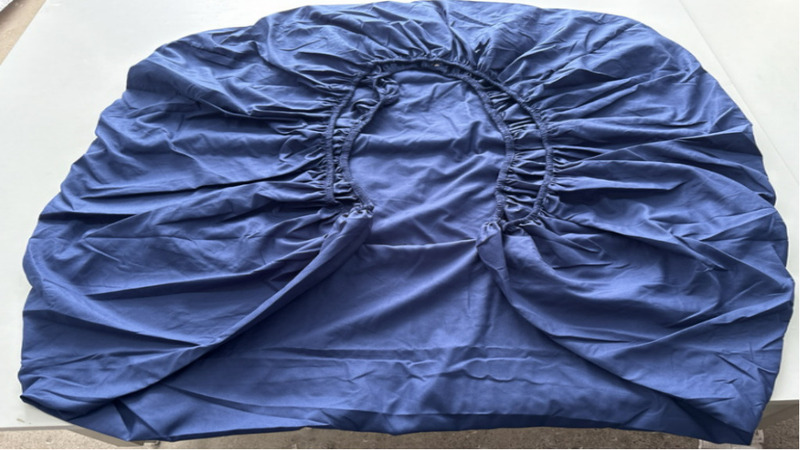
Fitted sheet pocket depth is one of the easiest details to miss.
Many U.S. mattresses are thicker than the size name suggests. Pillow tops, mattress pads, protectors, and toppers can all add height.
If the pocket is too shallow, the fitted sheet may pull up at the corners after use or washing.
Elastic construction also matters.
Corner elastic can work for basic home use. All-around elastic is usually more stable for thicker mattresses, rental units, dorm projects, and frequent washing.
Before sampling, confirm the target mattress height, pocket depth, elastic style, and size tolerance.
Factory Note: Check Fit Before Sampling
For U.S. bedding orders, a size name is not enough.
A buyer may ask for Queen, King, or Twin XL. Before sampling, we still need the finished measurements.
For a bed in a bag comforter set, we usually check three points first: comforter size, fitted sheet pocket depth, and elastic style.
Pocket depth is where problems often start. A mattress pad, topper, or pillow-top mattress can add height. If the pocket is too shallow, the fitted sheet may pull up at the corners after use or washing.
Elastic style also matters. Corner elastic can work for basic home use. For thicker mattresses, rentals, dorms, or frequent washing, all-around elastic is usually more stable.
If the buyer needs a deeper pocket, confirm it before sampling. A deeper pocket can change fabric usage, seam position, and fit after washing.
Compare Fabric and Fill Options

For value-focused bed in a bag comforter sets, buyers usually look for a soft feel, easy care, stable color, and a workable cost.
The best fabric is not always the most expensive one.
The right fabric is the one that fits the product position, sales channel, and target cost.
Common Shell Fabrics
Brushed microfiber is a common choice for value retail and online bedding programs.
It feels soft, works well for solids and prints, packs efficiently, and is easy to care for.
Cotton/poly blends can work for upgraded value programs.
The blend can help balance softness, durability, wrinkle control, and cost.
Cotton is usually better for higher-tier programs.
It gives a more natural feel, but it can wrinkle more and usually costs more than microfiber.
Common Comforter Fills
Polyester fiberfill is widely used in value bedding programs.
It is down-free, easy to care for, and helps keep the set at a workable cost.
Down alternative fill is also synthetic, but it is often used when buyers want a softer or fuller feel.
Higher-loft polyester fill can work when buyers want more volume and better shape recovery .
For value retail and online programs, brushed microfiber with polyester fiberfill is often a practical starting point.
For private label or upgraded retail programs, buyers can review cotton/poly blends, cotton shells, or softer down alternative fills based on the target price point.
Plan Design, Color, and Seasonal Direction
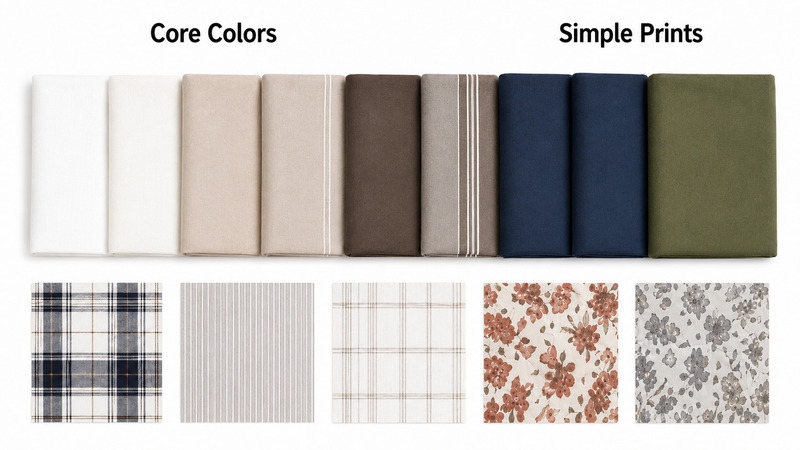
Design affects more than style.
It affects product photos, shelf presentation, SKU planning, inventory risk, and repeat-order planning.
A good design plan should be easy to present, sell, and reorder
Start With Core Colors
Solid colors are a practical base for many value retail, online, wholesale, and rental programs.
White, light gray, beige, navy, and soft blue are useful starting colors.
These colors work across many room styles and are easy to match with sheets, shams, blankets, and throw pillows.
Soft fashion colors can be added when they fit the buyer’s customer base. Blush, sage, warm taupe, and light green can give the line a softer home look without making the range too wide.
Keep Prints Easy to Use
Printed comforter sets can work well for online bedding, seasonal programs, kids’ bedding, and private label collections.
For value-focused programs, simple prints are usually easier to manage than large or high-contrast patterns.
Small florals, clean stripes, soft geometric prints, and low-contrast designs can add style without making the set too narrow.
The print should also scale well across sizes.
A pattern that looks balanced on Twin should still look balanced on Queen and King.
Use Reversible Designs When They Add Value
A reversible comforter can give one set two usable looks.
A common approach is to use a simple print on one side and a matching solid color on the other.
This can make the set feel more flexible without adding more pieces.
The reverse side should still look complete on its own. If the reverse color feels disconnected from the main design, the whole set may look less coordinated.
Add Accessories Only When They Help
Throw pillows, blankets, and bed skirts can make a set look more complete.
They can help with retail display, product photos, and private label programs.
But they also add cost, packing volume, and more details to manage.
For price-sensitive online programs, a simpler 5-piece or 6-piece set may be better.
Use accessories when they make the set easier to present, not just when they raise the piece count.
Confirm Packaging, Labels, and Carton Details
Product specs and packing specs should be confirmed together.
Packaging affects cost, shipping volume, warehouse receiving, retail display, and repeat-order planning.
Do not leave packaging until the product is ready to pack.

Match Packaging to the Channel
Retail programs may use a zipper bag, printed polybag, handle bag, insert card, or retail box.
The package should show the piece count, size, color, product image, barcode, and main product details.
Online programs may prefer compact packing or vacuum packing to reduce shipping volume.
Wholesale and project orders may use simpler packing when the main goal is product protection and warehouse handling.
Before production, confirm the bag type, insert card, carton quantity, carton size, and buyer-specific packing requirements.
Factory Note: Confirm Packaging With the Sample
For bed in a bag orders, we prefer to check the product sample and packed sample at the same time.
The product may be correct, but the packaging can still cause problems. Insert cards, size marks, barcode position, bag type, carton marks, and carton quantity all affect the final packing plan.
Packing method matters too. A folded set and a vacuum-packed set may need different carton sizes. That can change loading volume and, in some cases, the quotation.
For retail and private label programs, confirm packaging during the sample stage. Do not leave it until the goods are ready to pack.
This keeps the product, packaging, carton plan, and quotation aligned before bulk production.
Check Label Details Early
Labels should match the actual product inside the package.
For U.S. orders, buyers and importers usually confirm fiber content, country of origin, responsible company information, care instructions, size, piece count, and filled bedding label details, if required.
If different pieces use different materials, the label should state that clearly.
Before labels are produced, confirm the wording, label position, label material, and approval process.
Confirm Barcodes and Carton Marks
Barcodes should be checked before packaging artwork is finalized.
Retail orders may need UPC, GTIN, item labels, warehouse labels, pallet labels, or routing labels.
The barcode should be printed at the correct size, with enough quiet zone around it. It should also be tested with a scanner before bulk production.
Carton marks should help the buyer’s warehouse receive and sort the goods.
Carton marks often include item number, product description, size, color, piece count, carton quantity, gross weight, net weight, carton dimensions, country of origin, and handling marks.
For private label, retail, and large wholesale orders, ask for the buyer’s carton mark template before printing.
Approve the Sample Before Bulk Production
The approved sample becomes the production standard.
It should match the spec sheet, color standard, materials, measurements, labels, and packaging plan.
If one detail is wrong in the approved sample, the same issue may appear in bulk.
Check Color, Fabric, and Fill
Check the sample color under daylight or the buyer’s approved light source.
Compare it with the approved swatch, lab dip, or color reference.
For printed sets, check print placement and balance across the target sizes.
Check the fabric hand feel against the approved sample or swatch. For the comforter, check fill distribution, loft, and softness.
If the comforter is vacuum packed or tightly packed, open the sample and let it rest before approval.
Then check whether the loft and shape recover as expected.
Confirm Measurements and Fit
Measure each piece against the spec sheet.
Check the comforter, fitted sheet, flat sheet, pillowcases, and shams.
For fitted sheets, pocket depth and elastic construction are key fit points.
They should match the target mattress height and the approved tolerance.
Do not judge fit by eye alone.
Wash the Sample When Needed
Wash the sample according to the care instructions or the buyer’s test method.
After washing and drying, check shrinkage, color change, seam condition, pilling if required, and the overall appearance.
For rental, dorm, hospitality, or frequent-use programs, wash performance matters more than how the set looks right out of the bag.
Review Workmanship and Packing
Check stitching, seams, quilting lines, edge finish, elastic, labels, barcodes, insert cards, polybags, and carton marks.
Loose threads, skipped stitches, uneven quilting, and weak seams should be corrected before bulk production.
If any detail changes after sample review, update the spec sheet before final approval.
Approve the Sample in Writing
Sample approval should be confirmed in writing.
A short approval email is usually enough.
Include the style number, sample date, approved details, and any corrections still required.This gives the buyer, factory, and inspection team one shared reference during production.
Frequently Asked Questions About Bed in a Bag Comforter Sets
Q1:What is the difference between a comforter set and a bed in a bag?
A comforter set usually includes the top-of-bed pieces, such as a comforter and shams.
A bed in a bag usually adds sheets and pillowcases, so the customer gets one coordinated bedding set in one package.
For wholesale buyers, this affects piece count, price, packing size, product listing, and carton planning.
Q2: What should buyers confirm before sampling?
Confirm what goes into the bag first.
This includes the piece count, size range, finished measurements, fabric, fill, fitted sheet pocket depth, elastic style, labels, and packaging.
For U.S. orders, do not rely on the size name alone. A Queen or King label is only the starting point.
Q3: What should buyers check before bulk production?
Check the sample against the spec sheet.
Measure the pieces. Test the fitted sheet fit. Check the comforter loft, stitching, labels, barcode position, and packaging.
If the set is vacuum packed, open it and let the comforter recover before approval.
For rental, dorm, or hospitality programs, wash the sample before final approval.
Final Thoughts
A bed in a bag order runs better when the main details are clear before sampling.
Start with the set structure, size range, fabric, fill, packaging method, and sample approval requirements.
Then confirm labels, barcodes, carton marks, and buyer-specific packing needs.
A clear spec sheet makes the next steps easier: quotation, sampling, production, inspection, and repeat orders.
Work With Dongyu Textile
Dongyu Textile produces bed in a bag comforter sets for B2B bedding programs.
We support practical fabric choices, flexible piece counts, private label details, packaging coordination, and sample-to-bulk follow-up.
If you are sourcing bed in a bag comforter sets, send us your size range, piece count, fabric request, target price, order quantity, and packaging requirements.
We can review the details and help prepare a workable spec for quotation and sample development.