

Bulk microfiber sheets are widely used in commercial bedding, but a successful program depends on more than GSM and unit price. Fabric construction, fitted-sheet fit, wash performance, packaging, and production consistency all influence whether the product meets its intended use.
From our factory experience, many problems begin when key specifications are unclear during sampling or change before bulk production. Keeping the approved sample, current spec sheet, and order requirements aligned helps reduce avoidable differences from quotation through shipment.
This guide explains where microfiber fits in commercial bedding, which specifications matter before quotation, how to evaluate samples and wash performance, how to compare quotes, and how to control bulk production.
The starting point is simple: make sure microfiber matches the program’s price point, care requirements, and expected performance.
Microfiber Sheets for Commercial Bedding Programs
Microfiber is widely used in commercial bedding programs where buyers need to balance softness, easy care, and cost. From a sourcing standpoint, GSM, finish, and fitted-sheet construction can also be adjusted around the target price and end use, giving buyers room to build different programs within the same material category.
Common Commercial Applications
In my experience, microfiber works best when easy care and controlled cost matter more than a premium natural-fiber feel. Common applications include:
- Retail and e-commerce: target price, hand feel, and presentation
- Rental properties and furnished apartments: easy care and replacement cost
- Hotels and other lodging properties: laundering frequency and operating cost
For these programs, I would pay less attention to chasing a higher GSM and more attention to whether the fabric construction and wash performance fit the way the sheets will actually be used.
When Another Material May Be a Better Fit
Microfiber is not the right choice for every bedding program. If breathability, a crisp natural hand, or a more premium guest experience is the priority, cotton or a cotton-rich blend may make more sense.
Once the material fits the end use, price point, and laundry requirements, the next step is to define the GSM, finished dimensions, pocket depth, elastic construction, and packaging for sampling and quotation.
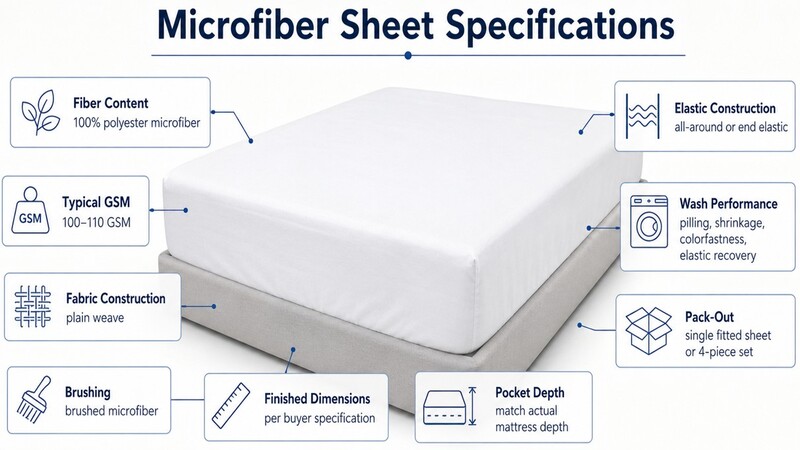
5 Key Product Specifications for Microfiber Sheet Quotations
Once microfiber has been selected for the program, the next step is to set the specifications suppliers will quote against. Fabric weight, fitted-sheet construction, finishing, and packaging can all affect cost, so these details need to be aligned before unit prices are compared.
Fiber Content, GSM, and Fabric Construction
For commercial microfiber sheets, GSM is the usual reference for fabric weight, but it does not tell you everything about the fabric. Construction and finishing also affect hand feel, appearance, and how the material performs after repeated washing.
Your RFQ should identify the fiber content, target GSM, fabric construction, and required finish. I have seen two quotes look quite different simply because one was based on a lower GSM or lighter construction. Before comparing unit cost, I make sure the fabric specifications are aligned.
Brushing and Hand Feel
Brushing gives microfiber its soft surface, but the first touch can be misleading. A sample may feel good when new and look quite different after laundering, which is why I prefer to compare the original fabric with a washed sample.
Look for changes in surface appearance and hand feel, especially fuzzing or pilling. For commercial bedding, the useful question is not how soft the sheet feels out of the package, but whether that feel and appearance remain acceptable in use.
Finished Dimensions, Pocket Depth, and Elastic
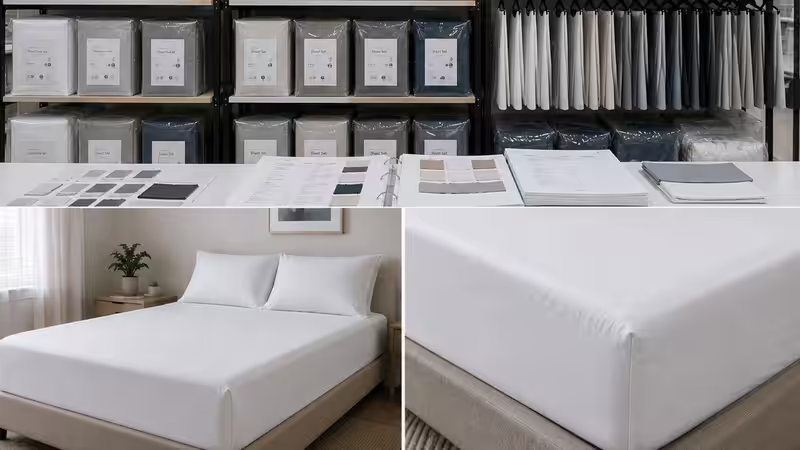
“Queen” or “King” is not enough to define a fitted sheet for production. The factory also needs the finished dimensions, mattress depth, pocket depth, elastic construction, and size tolerance.
Key fit specifications include:
- Finished dimensions
- Target mattress depth
- Pocket depth
- Elastic construction
- Size tolerance
I prefer to check the actual mattress fit during sampling. The fabric can meet the approved spec and the sheet can still perform poorly if the pocket is too shallow or the elastic does not hold securely.
Wash and Performance Requirements
For hotels, rental properties, furnished apartments, and other high-turnover programs, wash performance should be defined before sample approval. Buyers usually look at pilling, shrinkage, colorfastness to laundering, seam condition, and elastic recovery because these directly affect fit and appearance over time.
The RFQ does not need to read like a laboratory protocol. But if shrinkage or pilling performance matters to the program, both sides should know what will be checked and under what washing conditions.
Set Configuration and Pack-Out
The quote also needs to reflect exactly what goes into each selling unit. A single fitted sheet in a polybag requires a different pack-out from a retail sheet set with custom labels, inserts, barcodes, and branded packaging.
Define the main packing details early :
- Set configuration
- Labels and artwork
- Unit packaging
- Case pack and carton marks
We normally approve the final pack-out with the product sample. Late changes to labels, barcodes, inserts, or retail packaging can add cost and affect the production schedule.
Once these five specifications are clear, supplier quotes are much easier to compare on the same basis. The next step is to check whether the sample meets those specs—and what changes after laundering.
Microfiber Sheet Quality Evaluation Before Bulk Production
Once the product spec is set, the sample should confirm that the sheet was made correctly and still performs acceptably after laundering. We normally review it before washing, then compare it with the washed sample.
Pre-Wash Sample Review
Before laundering, check GSM, color, finished measurements, pocket depth, elastic, seams, and workmanship. If the sample is outside the approved spec, correct it before wash testing.
For fitted sheets, I pay particular attention to finished measurements and mattress fit. The fabric can be right and the finished sheet can still fit poorly if the pocket depth or elastic is off.
Post-Laundering Performance Review
Compare the washed sheet with the original sample and look for changes that matter in use:
- Surface fuzzing or pilling
- Shrinkage or dimensional change
- Loss of fitted-sheet fit
- Color change or surface dulling
- Noticeable change in hand feel
- Seam distortion
- Loss of elastic recovery
For hotels, rental properties, furnished apartments, and other high-turnover bedding programs, some wear over time is expected. The practical question is whether fit, appearance, and hand feel remain acceptable for the intended use and replacement cycle.

From Our Factory Experience — What Repeated Laundering Reveals
After years of working with microfiber, I have learned not to judge a fabric by its initial softness. Brushing can give a new sheet a soft hand, but repeated laundering tells you more about surface stability and how the fabric begins to wear.
With some 100–110 GSM microfiber constructions we have handled, visible wear has started to show at roughly 80–120 wash cycles in our internal observations. I would not use that as a service-life claim. Detergent, wash temperature, drying conditions, fabric construction, and finishing can all change the result.
What I watch for is simple: more fuzzing or pilling, a duller surface, a firmer hand, dimensional change, or weaker fitted-sheet recovery. If wash performance matters to the program, agree on the laundering conditions and review a washed sample before final approval.
Microfiber Sheet Supplier Evaluation and Quote Comparison
Once the product spec and approved sample are set, the key question is whether each quotation is based on the same product. From the factory side, a clear RFQ matters because GSM, fitted-sheet construction, pack-out, MOQ, and shipping terms can all change the price.
Compare Quotes Against the Same Specification
A buyer may receive two initial quotes like these for a Queen four-piece microfiber sheet set :
| Item | Supplier A | Supplier B |
| GSM | 90 GSM | 110 GSM |
| Pocket Depth | 14 in. | 14 in. |
| Pack-Out | Basic polybag | Polybag + printed insert |
| MOQ | 300 sets | 500 sets |
| Unit Price | $6.50/set | $7.20/set |
| Production Lead Time | 30 days | 35 days |
| Incoterm / Port | FOB Shanghai | FOB Ningbo |
*Illustrative pricing only; actual quotes vary by specification, quantity, packaging, and terms.
Supplier A looks cheaper, but the offers use different fabric weights, pack-outs, MOQs, and shipping terms. Before choosing a supplier, compare quotations on the same product specification and commercial basis. Only then does the price difference become meaningful.
Evaluate Repeatability, Not Just the Opening Price
Price is only part of supplier evaluation. Buyers should also ask how the factory controls GSM and shade, finished measurements, label placement, and pack-out against the approved sample.
From our side, these are the details we watch closely on repeat POs. If fabric weight, fitted-sheet fit, or packaging changes from one run to the next, a small first-order saving can disappear through rework, claims, or replacements.
For an ongoing bedding program, consistent production against the approved spec is usually more valuable than the lowest opening quote.

Bulk Production Control Against the Approved Sample
Once the order is approved for bulk production, the job is to keep the finished goods aligned with the approved sample and final spec. Small changes in fabric, sizing, elastic, labels, or pack-out are easier to correct early, so in our factory we review the order at three key points before too much material or labor is committed.
From Our Factory Experience — Three-Stage Production Sign-Off
Stage 1 — Pre-Production Sample
The pre-production sample, or PPS, sets the working reference before bulk cutting. We confirm:
- Fabric construction and GSM
- Color, finish, and hand feel
- Finished measurements
- Product construction
If something does not match the final spec, this is the right time to correct it. Once cutting begins, even a small change can affect a much larger part of the order.
Stage 2 — First Production Set
When the first complete set comes off the sewing line, we compare it with the approved sample and current spec sheet. The review covers finished measurements, pocket depth, elastic, fitted-sheet fit, stitching, labels, and workmanship.
For fitted sheets, I pay closest attention to pocket depth, elastic, and actual mattress fit. The fabric can be correct while the finished sheet still fits poorly.
Stage 3 — First Packed Set
Before full pack-out begins, we review one complete packed set for folding, inserts, barcodes, label placement, retail packaging, and carton marks. On private-label and retail programs, packaging accuracy matters because a wrong barcode or carton mark can create receiving or shipping problems even when the product itself is correct.
Keep the Final Approved Sample With Production
After the product and packaging are signed off, we keep one final approved sample—often called a golden sample—with the current PO and spec sheet. It gives production and QC one physical reference for fabric, color, construction, labels, artwork, and packaging.
The same reference is useful on repeat POs, helping the team work from the same approved standard instead of an older development sample or email thread.
Catch Problems While They Are Still Manageable
Incoming fabric checks should cover GSM, shade, usable width, and visible defects. In-line inspection should focus on measurements, fit, stitching, and workmanship, while final or pre-shipment inspection confirms finished goods, quantities, labels, pack-out, and carton marks.

If independent verification is required, the buyer can also arrange third-party inspection. From a production standpoint, a fabric issue found before cutting or a sizing problem caught early on the sewing line is much easier to correct than the same issue found after packing.
Bulk Microfiber Sheet Order Management: RFQ to Shipment
Once the product spec and approved sample are set, the order needs one current reference from quotation through shipment. Problems often start when an old spec, artwork file, or packaging instruction stays in circulation, so we keep sales, production, QC, and packing on the same approved version.
RFQ and Product Requirements
For an accurate microfiber sheet RFQ, we ask buyers to send the sizes, target GSM, order quantity, colors, pocket depth, set configuration, and packaging requirements. A current spec sheet or reference sample helps us price the right construction without filling in missing details.
If the program has a target cost, it is useful to know that early. We can then adjust fabric construction or pack-out before sampling instead of making cost-driven changes after approval.
PO and Commercial Terms
Before we release the order to production, we check the buyer’s PO against the approved sample and current spec sheet. The commercial terms should cover :
- Order quantity and unit price
- Payment terms
- Production lead time
- Inspection requirements
- Incoterm and named port or place
One point I always make clear is when the production lead time starts. Depending on the order, that may be after the deposit, final sample approval, or final artwork and packaging approval.
Production and Shipment
Bulk production follows the approved sample and current spec sheet, with in-line checks where needed. Before shipment, we confirm quantities, workmanship, labels, pack-out, carton marks, and agreed inspection requirements.
The product quoted, approved, produced, and shipped should stay consistent from one stage to the next. Once the order meets the agreed requirements, it can be released for shipment under the confirmed terms.
Bulk Microfiber Sheets: Sourcing FAQ
What GSM Should Buyers Specify for Microfiber Sheets?
There is no single GSM for every program. For microfiber, GSM is more useful than thread count for comparing fabric weight. Choose around target cost, hand feel, end use, and laundering requirements.
How Should Buyers Evaluate Commercial Wash Performance?
Review a washed sample under agreed laundering conditions. Check pilling, dimensional change, color change, seam condition, and elastic recovery. For high-turnover programs, focus on whether fit and appearance remain acceptable through the intended replacement cycle.
What Pocket Depth Should Buyers Specify for U.S. Fitted Sheets?
Start with the actual mattress depth, including any topper or mattress pad. Confirm finished pocket depth and mattress fit during sampling rather than relying on bed size alone. Commercial fitted sheets are sold with different pocket depths, so there is no single depth for every program.
What Should Be Included in a Microfiber Sheet RFQ?
Include finished dimensions, target GSM or target cost, quantity, colors, pocket depth, set configuration, packaging, and testing requirements. Send the current spec sheet, reference sample, artwork, and packaging files when available.
Next Steps for Your Microfiber Sheet Program
Before moving to quotation or sampling, bring the key requirements into one current specification: intended use, target cost, GSM and construction, finished dimensions, pocket depth, wash requirements, packaging, quantity, and inspection needs.
Use the same specification throughout quotation, sample approval, and bulk production. If you already have a spec sheet or reference sample, send it with the RFQ so the factory can review the product on the same basis from the beginning.
Bulk Microfiber Sheet Manufacturing With Dongyu Textile
Dongyu Textile is a China home textile manufacturer with more than 15 years of production experience, supporting OEM, ODM, and private-label bedding programs from sampling through bulk production.
If you are developing a bulk microfiber sheet program, send us your current specification or sample requirements. We can review the construction, sizing, packaging, and order details with you and prepare a quotation or sample based on the requirements of your project.