

Choosing pillow sham sizes for a wholesale or private-label program involves more than matching a retail size name to an insert. Finished body measurements, flange width, closure construction, and fabric shrinkage all affect how the sham fits and looks on the bed.
After more than 15 years in bedding production, I have seen unclear specifications lead to undersized shams, extra sample rounds, and avoidable delays. The problem usually begins when the buyer, factory, and inspector use different dimensions or measuring methods.
This guide covers common U.S. pillow sham sizes, what to include in a spec sheet, and how to control sizing through sampling, bulk production, labeling, and final inspection. Start with the size chart below, then use the sourcing checklist before moving into production.
Common U.S. Pillow Sham Sizes
U.S. retailers use familiar size names such as Standard, King, and Euro, but finished dimensions can vary by brand and construction. For a wholesale order, the approved spec sheet—not the retail size name—should control sampling, production, and inspection.
U.S. Pillow Sham Size Chart
| Pillow Sham Size | Common U.S. Dimensions | Typical Use |
| Standard | 20 × 26 in. | Twin, Full, and many Full/Queen programs |
| Queen or Standard/Queen | 20 × 30 in. | Programs with a dedicated Queen size |
| King | 20 × 36 in. | King and California King programs |
| Euro | 26 × 26 in. | Decorative and layered bedding programs |
Standard shams at 20 × 26 inches, King shams at 20 × 36 inches, and Euro shams at 26 × 26 inches are common reference sizes in the U.S. market. Use them as a starting point, then confirm the finished body dimensions, flange width, and overall edge-to-edge dimensions for the specific product.

Queen and Euro Size Variations
Queen sizing varies more by brand. Some retailers offer a separate 20 × 30-inch Queen or Standard/Queen sham, while many Full/Queen bedding sets use a 20 × 26-inch Standard sham to reduce SKU count. The right choice depends on the retailer’s pillow insert assortment and set configuration.
Euro shams are commonly 26 × 26 inches, although private-label programs may use 24 × 24, 27 × 27, or other custom sizes. Test the intended pillow insert during sample approval because insert loft and fill level affect fullness, corner shape, and closure coverage.
Retail Size Names vs. Finished Dimensions
A retail size name is not a production specification. The spec sheet should separate the pillow insert size from the dimensions used for production and inspection:
- Nominal insert size: The pillow size the sham is designed to fit
- Finished body dimensions: Measured between the agreed seam or stitch lines
- Overall finished dimensions: The full edge-to-edge size, including the flange
- Dimensional tolerance: The allowable variation for production and inspection
For example, a sham designed for a 20 × 26-inch insert may have a 20 × 26-inch finished body with a 2-inch flange on all four sides. Its overall finished dimensions would be 24 × 30 inches.
In our experience, most size disputes begin with unclear measurement points rather than poor sewing. The approved sample, spec sheet, purchase order, and inspection plan should use the same dimensions and measurement method.
What to Include in a Pillow Sham Spec Sheet
A pillow sham spec sheet gives the buyer, factory, and inspector a single production reference. Before sampling, it should define the finished dimensions, construction details, measurement points, and dimensional tolerance.
List Each Measurement Separately
Do not combine the pillow insert size, finished body dimensions, and overall edge-to-edge dimensions in one field. List each separately, and state the measurement stage for the finished sham—for example, after sewing and before washing, or after the approved wash test.
Pillow insert size: 20 × 26 in.
Finished body: 20 × 26 in., measured seam to seam
Flange width: 2 in. on all four sides
Overall finished size: 24 × 30 in.
Dimensional tolerance: ±0.5 in.
Measurement stage: After sewing, before washing
This separates insert fit from finished-product measurements. The ±0.5-inch tolerance is only an example; the approved limit should reflect the fabric, construction, measurement stage, and inspection plan.

Include Details That Affect Finished Size
The cutting pattern should account for details that can change the finished dimensions:
Seam allowance and flange width
Envelope closure overlap or zipper placement
Piping, binding, or decorative borders
Quilting or embroidery take-up
Expected fabric shrinkage
A small change to the flange, closure, quilting, or trim can shift the final dimensions. Confirm these details before bulk cutting so production starts with the approved pattern.
Use One Measurement Method
Before production, the buyer and factory should agree on one measurement method. The spec sheet, approved sample, purchase order, and inspection report should use the same measurement points, measurement stage, and tolerance.
If one document measures seam to seam and another measures edge to edge, a correctly sewn sham may still appear out of tolerance. Using one method keeps production and inspection aligned.
How to Keep Pillow Sham Sizes Consistent in Bulk Production
Once the pillow sham spec sheet is approved, the factory must keep the bulk order within the agreed dimensional tolerance. Most size variation comes from fabric shrinkage, inconsistent seam allowances, or different measurement points. These risks are easier to control before cutting than after finished goods require rework or production delays.
Test Shrinkage Before Bulk Cutting
Fiber content is only one factor that affects shrinkage. Fabric construction, finishing, wash temperature, and drying method can also change the final dimensions. The approved fabric should therefore be tested under the same wash-and-dry conditions used to establish the care instructions.
When preshrinking is required, the fabric should be treated before cutting, and the pre-production sample should be made from material prepared in the same way.
For initial evaluation, the following ranges may be used as general shrinkage references. Final requirements should be based on test results from the approved fabric:
- 100% cotton: About 3%–5%, depending on fabric construction and finishing
- Poly-cotton blends: Often around 1%–2%, subject to actual testing
- Linen: Greater lot-to-lot variation; some programs use post-wash dimensions for acceptance
These figures should not be used as bulk-production tolerances. For orders with tight finished-size requirements, treated and untreated samples can be wash-tested before the buyer approves the post-wash dimensions.
Control Cutting Patterns and Seam Allowances
Preshrinking cannot correct an inaccurate cutting pattern or inconsistent sewing. We control finished dimensions through approved patterns, fixed seam allowances, in-line measurements, and pair-matching checks. QC verifies seam allowances during sewing so the production line can correct any drift before it affects a larger quantity.
For King shams packed as a pair, we place both shams together and compare the finished size, print direction, and quilting placement. Each sham may fall within tolerance and still appear mismatched when displayed side by side.
Check Dimensions During Production
The pre-production sample confirms construction, pillow insert fit, finished dimensions, and wash performance. In-line inspection identifies cutting or sewing variation early, while final inspection compares the bulk goods with the approved sample, dimensional tolerance, and agreed measurement points.
The purchase order and inspection plan should also state the measurement stage and whether the sham is measured seam to seam or edge to edge. Using the same instructions throughout production and inspection prevents different teams from applying different standards to the same order.
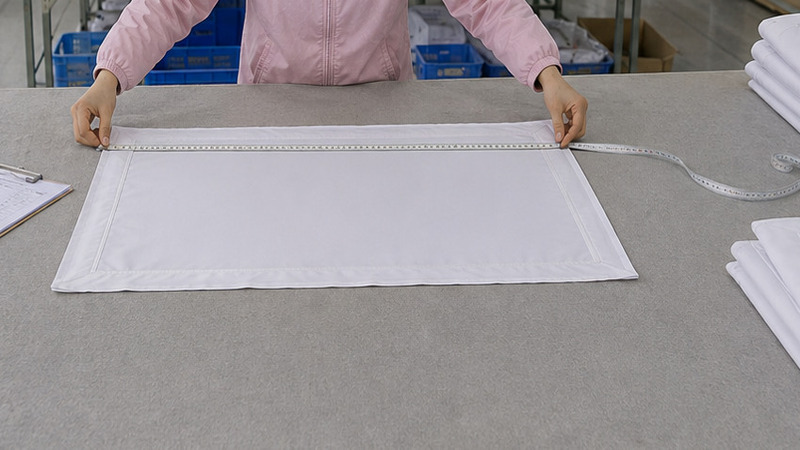
Production Case: Cut Size Was Used as Finished Size
A distributor once sent us a King sham made by another supplier. It was intended for a 20 × 36-inch pillow insert but measured only about 19.5 × 35 inches. The factory had used the cut dimensions as the finished specification, leaving no allowance for sewing or shrinkage.
About 3,000 shams had already reached a third-party fulfillment center. The distributor estimated that the resulting returns, storage, and rework costs exceeded $20,000.
For the replacement order, we listed the cut, sewn, and post-wash dimensions separately and added finished-size checks to the final inspection. Inspection followed the agreed ISO 2859-1 sampling plan, while the purchase order defined the measurement method and dimensional tolerance.
U.S. Labeling and Order Documents
For U.S. pillow sham orders, size and construction approval is only part of the production handoff. Before bulk production, finalize the label artwork, care instructions, packaging copy, and inspection documents. Keep the factory, packaging supplier, and inspector working from one approved revision to reduce relabeling, repacking, and shipment delays.
Review Label Details Before Printing
Pillow shams are generally covered by U.S. textile labeling requirements. The label should identify the generic fiber names and percentages by weight, country of origin, and the manufacturer, importer, or other responsible business. An eligible U.S. company may use an FTC-issued RN instead of its full business name; the RN is optional.
Before printing, verify that:
- Fiber names and percentages match the approved fabric
- The company name or RN is correct
- The country-of-origin statement has been confirmed
- Required information is clear and accessible
- Label placement and artwork match the approved sample
When production involves more than one country, the importer should confirm the origin statement under the applicable CBP rules. Do not assume that the country where the sham is sewn automatically determines its origin. Bulk labels should be printed only from the final approved artwork.
Match Care Instructions to the Finished Product
The federal Care Labeling Rule generally does not apply to finished pillow shams, although retailers and private-label buyers may still require permanent care information.
Base the wording on the complete product rather than fiber content alone. Quilting, embroidery, piping, dyes, and decorative finishes can affect suitable washing, drying, and ironing conditions. Where possible, confirm the instructions through finished-product testing and keep the sewn-in label, packaging, and online listing consistent.

Maintain One Controlled Production File
Keep one controlled file from sampling through shipment. Depending on the program, it may include:
- Approved spec sheet and sample reference
- Fiber-content declaration
- Wash and shrinkage results
- Final label and packaging artwork
- Country-of-origin confirmation
- Buyer-required reports or certificates
- Final inspection report
Agree on the document list before sample approval so missing reports or outdated artwork do not delay production or shipment.
Private Label Pillow Sham Development
Once the size, construction, labeling, and packaging are approved, the project should move forward with one controlled production package. The pre-production sample, approved spec sheet, test results, and final artwork must all show the same revision before bulk production begins.
Approve the Sample and Files Together
Spec Sheet → Pre-Production Sample → Testing → Buyer Approval → Bulk Production → Final Inspection
The pre-production sample should confirm construction, pillow insert fit, hand feel, and overall appearance. The agreed test plan should cover dimensional stability, colorfastness, and finish performance under the specified care conditions.
Buyer approval should include both the physical sample and the files needed to reproduce it. We record the approved sample number with the current spec sheet, test report, and artwork revision so outdated dimensions, labels, or packaging files do not return to production after several development rounds.
Build the Size Mix Around Sales Data
There is no universal ratio for Standard, Standard/Queen, King, and Euro shams. The right mix depends on the buyer’s sales channel, assortment, SKU limits, inventory, and reorder history.
Review the available data:
- Pillow insert sizes in the assortment
- Sell-through by sham size and channel
- Sham sizes included with comforter, quilt, or duvet cover sets
- Current inventory and reorder frequency
Shams packed in bedding sets should follow the approved set configuration. For shams sold separately, pillow insert sales and previous reorders are usually more useful than bed-size sales alone. Build the order around actual demand, not a generic market ratio.
Cost Custom Sizes Before Sampling
Confirm the pillow insert size, finished body dimensions, flange width, and closure construction before costing and pattern development. Custom sizes can affect fabric consumption, cutting yield, packaging dimensions, unit cost, and lead time.
The finished-product MOQ may not be the main constraint. Custom fabric, printed packaging, piping, zippers, or other components can have separate minimums. Reviewing these details early gives the buyer a realistic view of cost, MOQ, and lead time before sampling begins.
Wholesale Pillow Sham Sourcing Checklist
Before releasing a bulk purchase order, confirm that the approved sample, spec sheet, label artwork, and inspection plan describe the same finished product. Version mismatches and unclear acceptance criteria often cause avoidable delays.
Confirm Size and Construction
For a flanged sham, record the finished body dimensions separately from the full edge-to-edge size. The factory and inspector should use the same measuring points, measurement stage, and tolerance.
Confirm:
- Pillow insert size
- Finished body and overall dimensions
- Flange width and construction
- Closure type and envelope overlap
- Measurement points and tolerance
Match the Sample and Test Records
The approved pre-production sample should represent the bulk fabric, construction, labeling, and packaging. Link the sample number to the current spec revision and state whether size acceptance is based on pre-wash or post-wash measurements.
Keep the required dimensional-stability, colorfastness, and performance reports with the order file.
Finalize Labels and Inspection Criteria
Before production release, approve the sewn-in label, packaging artwork, fiber content, country-of-origin statement, and any required reports or certificates.
The final inspection plan should define the measurement method, tolerance, inspection stage, and defect classifications. If acceptance sampling is used, state the agreed inspection level and AQL separately.

Pillow Sham Size FAQ
1. Are Queen pillow shams always 20 × 30 inches?
No. A 20 × 30-inch Queen sham is common, but not every bedding program uses a dedicated Queen size. Many Full/Queen sets use 20 × 26-inch Standard shams. Approve the pillow insert size, finished body dimensions, and overall edge-to-edge size instead of relying on the retail size name.
2. Should pillow sham dimensions be approved before or after washing?
The spec sheet and purchase order should state the measurement stage. For washable fabrics with meaningful shrinkage, record both the sewn dimensions and the post-wash acceptance dimensions under the agreed wash-and-dry conditions. Production and inspection should use the same measuring points and tolerance.
3. What dimensional tolerance should buyers use?
There is no single tolerance that suits every pillow sham. Set the limit according to the fabric, construction, finished size, measurement method, and whether acceptance is based on pre-wash or post-wash dimensions. Use the same tolerance in the spec sheet, purchase order, and inspection plan.
4. Can a factory produce custom pillow sham sizes?
Yes. Confirm the pillow insert size, finished body dimensions, flange width, and closure construction before costing and pattern development. Custom sizing can affect fabric consumption, cutting yield, packaging dimensions, component minimums, price, and lead time.
5. What should be included in the order file?
Keep the approved spec sheet, pre-production sample reference, test results, final label and packaging artwork, and inspection plan under the same revision. Add fiber-content declarations, country-of-origin confirmation, and buyer-required reports or certificates when applicable.
Before You Request a Sample or Quote
A pillow sham size name is only a starting point. Before sampling begins, confirm the pillow insert size, finished body dimensions, overall edge-to-edge size, flange width, closure construction, measurement stage, and dimensional tolerance. These details affect the fit, finished appearance, fabric consumption, and inspection criteria.
Keep all requirements in one product specification and use the same approved version for sampling, product testing, bulk production, and final inspection. This gives the buyer, factory, and inspector one clear reference for dimensions, construction, labeling, and packaging, reducing repeated confirmation and version errors during development.
Request a Custom Pillow Sham Sample or Quote
Dongyu Textile has more than 15 years of experience supporting wholesale and private-label bedding programs. We work with buyers on fabric selection, custom sizing, sample development, product testing, label and packaging coordination, bulk production, and final inspection follow-up.
To help us review your project, please provide:
- Pillow insert size and finished sham dimensions
- Fabric and construction requirements
- Target order quantity
- Label and packaging requirements
- Target market or sales channel
After reviewing the specifications, we will provide a sampling plan, MOQ, quotation, and estimated production lead time. Learn more about our bedding manufacturing capabilities, or contact us to discuss your pillow sham project.