
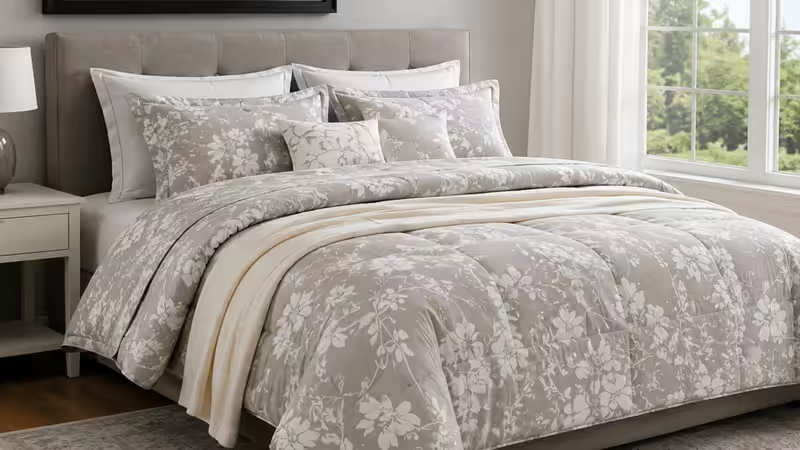
Most comforter quote problems start when suppliers use the same product name for different specifications.
In more than 15 years of bedding production, I have seen unclear specs lead to sample revisions, cost changes, packing problems, and delayed launches.
This guide covers five checks to make before ordering wholesale comforter sets: set structure, fabric and fill, sizing and construction, MOQ planning, and sample approval.
Set Structure: Know What You Are Quoting
Piece count is usually the first thing buyers compare, but it does not define the product.
A 5-piece set may be a basic top-of-bed set or include sheets. A 7-piece set may add decorative pieces rather than higher-value components.
Before comparing prices, confirm the item list, finished measurements, materials, labels, packaging, case pack, and master carton dimensions. A lower quote may cover a different set.
Comforter Set or Bed-in-a-Bag?
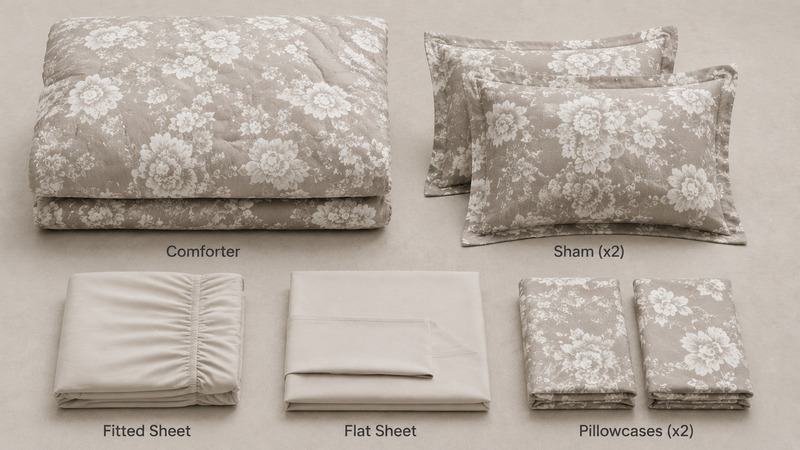
In the U.S. market, a comforter set usually centers on the top of the bed. It may include a comforter, pillow shams, a bed skirt, or decorative pillows.
A bed-in-a-bag usually adds a fitted sheet, flat sheet, and pillowcases. Retail naming varies, so the item list—not the package name—should control the quote.
When sheets are included, also confirm pocket depth, elastic construction, finished measurements, pillowcase sizes, labels, and packing method.
Use Piece Count as a Starting Point
A 3-piece comforter set often includes one comforter and two shams; Twin sets usually include one sham.
A 5-piece set may add decorative pillows. A 7-piece set may include a bed skirt, extra shams, or accessories.
Piece count helps sort offers, but a valid comparison must cover the same components, measurements, materials, packaging, and carton details.
Match the Structure to the Sales Channel
The right structure depends on the channel.
A fuller set can strengthen retail presentation. For online marketplaces, value retail, and price-sensitive wholesale programs, a simpler 3-piece or 5-piece set is often easier to price, pack, ship, and reorder.
Extra pieces add cost, packed volume, inspection points, and inventory risk.
Sheets work well for dorm rooms, first apartments, and complete bedding programs, but can reduce flexibility when colors or seasonal designs change.
A Practical Starting Point
For a new program, start with the simplest structure that fits the channel.
Choose a 3-piece set, 5-piece top-of-bed set, or bed-in-a-bag that is easy to quote, sample, pack, ship, and reorder. Add more pieces after it proves itself.
Fabric and Fill: Define Them Before You Compare Prices
After set structure, I move to fabric and fill.
These specs affect price, hand feel, packed volume, and bulk consistency.
If an RFQ only says “microfiber comforter set,” suppliers may quote different shell weights or polyester fills. Similar descriptions can produce very different samples.
Write the Shell Fabric Clearly
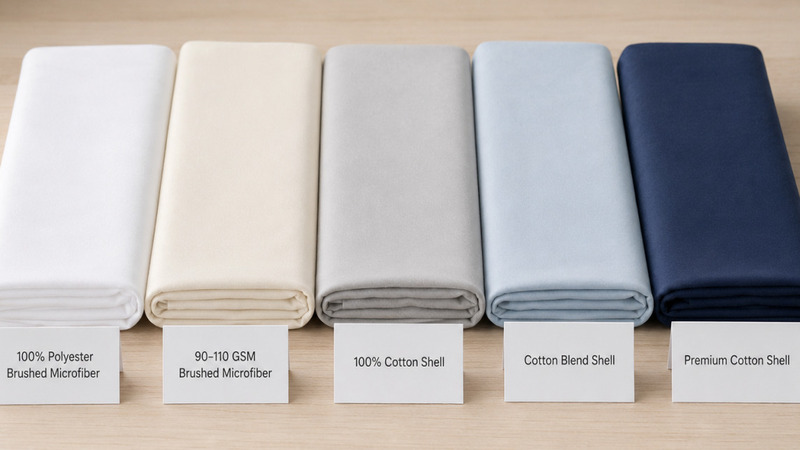
“Microfiber”is not a complete fabric specification.
For a comforter shell, I use:
100% polyester brushed microfiber, 100 GSM, solid color.
That gives the factory the fiber content, finish, fabric weight, and color requirement. Add the dyeing or printing method if needed.
For many U.S. value retail, e-commerce, and wholesale programs, 90–110 GSM brushed microfiber is a practical range. A lighter shell may cost less but feel thin after compression packing.
Match the Fabric to the Program
Brushed microfiber works well for many high-volume programs. It is soft, easy to care for, and consistent across repeat orders.
Cotton shells make more sense when natural fiber supports the product position, such as a premium private label or hospitality line.
The fabric should fit the price point, channel, and reorder plan.
Define the Fill Before Sampling
Words like “lightweight,” “all-season,” and “warm” work in product listings. They are not production specifications.
The spec sheet needs a fill type and target fill weight. Do not leave the weight as “supplier standard.” That usually means the factory will use what it normally runs for that shell and construction.
I saw this happen on an all-season Queen comforter program.
The sample room used about 48 oz to achieve the requested loft, but the weight never reached the final spec sheet. Bulk production used the line’s standard 38 oz, and the units felt lighter and thinner.
The approved sample showed the target loft, but the spec sheet gave production and QC no fill-weight target to control.
Record the fill type and finished fill weight for every size. Weigh the pre-production sample, then repeat the check on bulk units before shipment.
For polyester and down-alternative comforters, specify fill in GSM or as total fill weight by size. Use the same method through quotation, sampling, production, and inspection.
Fill type and quilting also affect loft. At the same weight, siliconized polyester fill can feel softer than standard polyester fiberfill. Tighter quilting controls movement but may reduce loft.
Check the Packed Sample
Fill affects both comfort and carton volume.
A warmer comforter takes more space, which can affect freight and landed cost.
Before approval, check the packed sample, case pack, master carton dimensions, and shipping volume. After opening, the product should still match the target.
Keep the Spec Consistent
The spec sheet should list the shell fabric, fabric weight, finish, fill, quilting, size tolerance, labels, packaging, and carton details.
The quote, pre-production sample, bulk goods, and inspection standard should follow the same specification.
Sizing and Construction: Do Not Quote by Size Name Alone
After fabric and fill, I check finished measurements and construction.
A size name is not a finished measurement. “Queen” does not tell the factory the comforter dimensions, side drop, tolerance, or intended look on the bed.
Use the Buyer’s Finished Measurements
U.S. comforter dimensions vary by retailer, brand, and program. A general size chart is only a reference.
The buyer’s finished measurements should control the order. For a comforter set, check the comforter and shams. For a bed-in-a-bag, also check the sheets, pillowcases, and other pieces.
Use the same measurements for quotation, sampling, inspection, and repeat orders. Later changes can affect materials, packaging, carton size, and price.
Check Sheet Fit When Sheets Are Included
With a comforter set, the main fit checks are the top-of-bed pieces. A bed-in-a-bag adds sheet fit.
For the fitted sheet, confirm target mattress depth, pocket depth, elastic construction, and finished-size tolerance before sampling.
Corner elastic may work for a basic value program. For thicker mattresses or frequent use, all-around elastic usually fits more securely.
Deeper pockets can change fabric consumption, seam placement, cost, and fit after washing. The pocket should match the target mattress; deeper is not always better.
Match Construction to the Program

Construction should match the price point and end use.
For many value and mid-market comforter sets, sewn-through box quilting is practical. It is cost-efficient, stable in bulk production, and easy to repeat.
Baffle-box construction allows more loft but adds fabric, labor, and production time. Use it only when the price point, fill, warmth level, and quality target support the added cost.
For hospitality, dorm, rental, or institutional programs, also check seams, quilting strength, and wash performance.
Check the Pre-Production Sample by Hand
A comforter can measure correctly and still feel uneven.
Press across the sample and look for thin areas, empty corners, shifting fill, or uneven quilting.
Lay it flat to check the quilting, then place it on the target bed size and compare the drop on both sides.
Before production, the measurements, tolerance, construction, fill distribution, and packed appearance should match the approved standard.
MOQ and First-Order Planning: Keep the First Order Workable
New comforter programs often get too wide too soon.
Buyers add colors, sizes, or custom details to meet a minimum, then face a harder assortment to sell and reorder.
For a first order, I prefer enough volume with fewer variables.
Control What Drives MOQ
MOQ changes with fabric, color count, size range, fill, quilting, packaging, and private label details.
Color count is usually the first place I look. Each color may require its own dye lot, print run, or fabric minimum.
For a first order, one core neutral and one secondary color are often enough.
I saw one buyer launch the same comforter in white, gray, navy, and sage green. White and gray sold steadily. Navy moved slowly, and sage sat for eight months.
The buyer dropped sage on the reorder and added warm taupe. The second assortment, based on actual sell-through, moved faster.
In the U.S. value retail, e-commerce, and wholesale programs I have worked on, white and gray are often practical opening colors. Use reorder data to decide what comes next.
Size range creates the same risk. A full run from Twin through California King means more SKUs, labels, cartons, and inventory.
In many U.S. programs I see, Queen is the lead size. King may also matter by channel. Add other sizes when the first order provides enough sell-through data.
Compare Quotes on the Same Scope
A lower FOB price only matters when each quote covers the same product.
Check whether every quote includes the same fabric, fill, quilting, measurements, tolerance, packaging, labels, barcode requirements, case pack, and master carton specification.
A retail package and a basic polybag are not the same scope. Neither are quotes that differ on custom labels, testing, or carton requirements.
Confirm Packaging Early
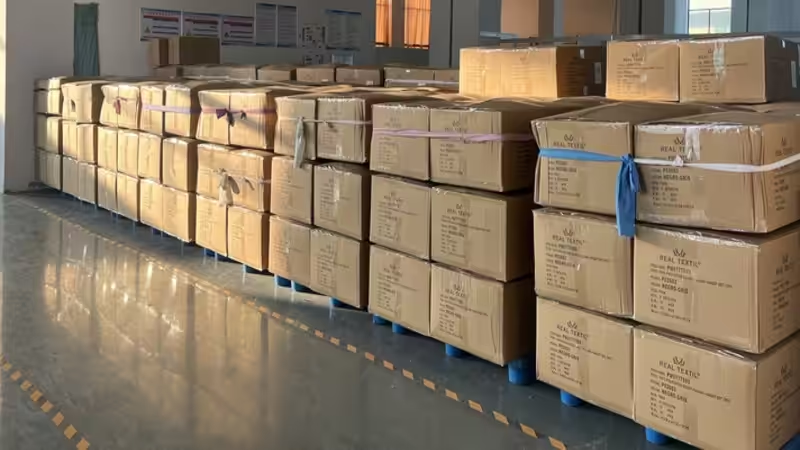
Packaging affects cost, carton volume, warehouse handling, retail presentation, and e-commerce fulfillment.
A polybag, vacuum pack, zipper bag, retail box, or shelf-ready package changes both cost and master carton size.
Retail and marketplace programs may also require GTIN/UPC data, barcode placement, state law labels, care information, routing labels, or specified materials.
Late details can change the quote. Heavy compression can also reduce loft or increase recovery time.
Confirm packaging with the product specification, not after sample approval.
Make the First Order Easy to Repeat
A first order should provide useful sales data and be easy to quote, sample, pack, inspect, and reorder.
Start with the structure, colors, sizes, materials, and packaging that fit the channel.
Keep the specification clear enough for the next run to follow. Add colors, sizes, or custom details after the first order provides sell-through data.
Sample Approval: Do Not Rush the Step That Protects the Order
Once the quote, spec sheet, and packaging details are clear, the approved pre-production sample and final spec sheet become the standard for bulk production.
I would not approve a comforter from photos or video alone.
Photos show color, shape, and quilting. They cannot show hand feel, loft, fill balance, or recovery after compression.
Check the Sample Against the Spec
Measure the comforter flat and compare it with the spec sheet. If it arrived vacuum packed, let it recover before judging loft or shape.
Compare the shell fabric, weight, finish, color, and hand feel with the approved swatch or specification.
Press across the comforter for thin spots, empty corners, shifting fill, or uneven quilting. Confirm the recorded fill weight and overall balance.
For frequent-use programs, wash the sample before approval. This can reveal shrinkage, seam problems, fill migration, or color loss.
Review Labels and Packaging
For a U.S. program, check the required federal textile disclosures: fiber content, country of origin, and the responsible company’s name or RN.
Also check the buyer’s care-label requirements and any state law labels that apply to filled bedding. If the shell and fill use different fibers, identify them separately.
Check the sewn-in label, not just the artwork. It should be readable, correctly placed, and securely sewn.
Open the packed sample, let it recover, and repack it. Before production, confirm the retail package, GTIN/UPC data, barcode placement, carton marks, case pack, and master carton dimensions.
Approve It in Writing
Before production, record the approved sample number, sample date, final spec sheet, packaging plan, and any agreed corrections.
A clear approval email should identify the approved sample and any remaining bulk-production changes.
Avoid “looks good” or “proceed as discussed.” Before bulk production, the spec sheet, sample, labels, and packaging artwork should agree.
Frequently Asked Questions
What Is a Realistic MOQ for a First Comforter Program?
MOQ depends on the fabric, color count, size mix, fill, packaging, and private label requirements.
For a first order, start with one or two colorways, core sizes, standard materials, and proven construction. Ask for the MOQ by colorway and size mix—not just one total number.
How Much Time Should I Allow for Sample Approval?
For planning, allow 7–15 days for a standard pre-production sample after the final specs are confirmed, plus transit time.
If revisions are likely, build in another sample round. Do not release bulk production until the sample, spec sheet, labels, and packaging are approved.
Do I Need to List the Shell and Fill Separately on a U.S. Textile Label?
Yes. For a comforter, list the fiber content of the shell and fill separately when they are distinct product components.
Also include the country of origin and the responsible company’s name or RN. Check the actual sewn-in label—not just the artwork—before bulk production.
Ready to Build Your Comforter Program?
Put the set contents, materials, finished measurements, colorways, packaging, and sample approval criteria into one clear product spec before requesting quotes.
If sheets are included, read our Bed in a Bag Comforter Sets: A Wholesale Buyer’s Guide before confirming the sheet specifications.
About Dongyu Textile
Dongyu Textile has more than 15 years of bedding production experience and supports retail, wholesale, e-commerce, hospitality, and private label programs.
Send Us Your Program Requirements
Send us your product spec, order quantity, packaging requirements, and target FOB.
We will review any open points and prepare a quote based on the same product scope.